Social commerce crossed $102 billion in U.S. sales last year. Every platform is claiming their slice. And yet, quietly, the brands winning in 2026 aren’t chasing checkout buttons — they’re chasing intent signals. There’s a difference, and it’s costing the brands who miss it.
Here’s the map.
How TikTok Shop Rewrote the Playbook — and What Brands Missed
TikTok Shop’s rise has been relentless. In-app checkout, native product listings, affiliate creator commissions, live commerce events — TikTok built the full funnel inside a single scroll. For brands who moved fast and seeded the right creators, the returns were real.
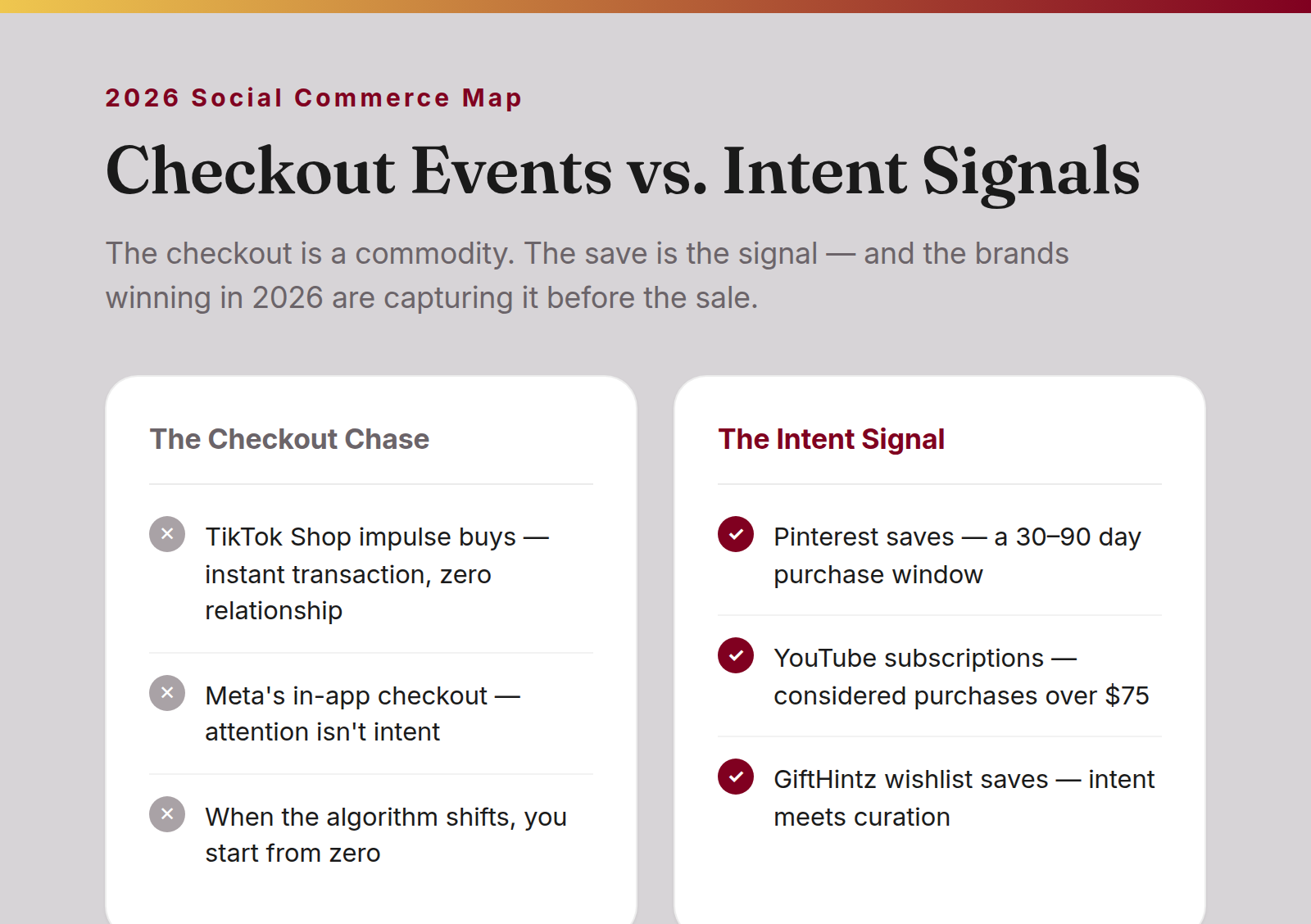
But there’s a structural problem baked into that model. TikTok Shop optimizes for impulse. A viewer sees a product during a live stream, taps through, and buys — or scrolls past and forgets. The transaction is instant; the relationship is zero. No saves, no signals, no insight into which customers were genuinely deliberating versus which ones clicked and returned.
When the algorithm shifts — and it always shifts — you’re starting from zero again.
The social commerce strategy 2026 winners aren’t just riding TikTok Shop. They’re using discovery platforms to feed an intent layer they actually own.
Meta’s Checkout Retreat and What It Signals for Smart Brands
Meta launched in-app checkout across Instagram and Facebook with enormous fanfare. It spent years, billions of dollars, and relentless developer resources to build a native commerce stack. By 2025, it had quietly retreated — pulling back in-app checkout from the majority of markets, pushing brands back toward off-platform purchases.
The lesson isn’t that Meta failed. It’s that in-app checkout solves the wrong problem. Meta’s strength is brand awareness at scale: attention. Attention is not intent. A user who double-taps a sweater post on Instagram is expressing appreciation. A user who saves it to a wishlist linked to a specific gift occasion — and shares it with someone who has a reason to buy — is expressing intent.
The brands who misread Meta’s retreat as abandoning social commerce are making the same mistake in reverse. Social is where discovery happens. The question is what you do with that moment before it evaporates.
Pinterest and YouTube: The Underrated Intent Machines
Pinterest’s 2026 updates doubled down on something most brands overlook: it is the only major social platform where users arrive with a purchase mindset. Pinterest users don’t browse out of boredom — they’re planning. Weddings, home renovations, seasonal gift lists. The purchase window from a Pinterest save to purchase extends 30-90 days, which means the brand that shows up during the planning phase earns the eventual sale.
YouTube’s shopping integrations have matured quietly: shoppable end cards, product shelves under long-form reviews, affiliate commissions that rival LTK. For brands selling considered purchases — anything over $75, anything that benefits from explanation — YouTube product mentions convert at rates that dwarf feed-based placements.
Both platforms share a signal that’s easy to overlook: the save and the subscription as pre-purchase signals. A product save on Pinterest, a channel subscription tied to a haul video — these are not vanity metrics. They’re the modern equivalent of walking into a store and picking something up. High consideration. Real intent. Invisible to any analytics dashboard that only counts checkouts.
The Real 2026 Social Commerce Strategy: Own the Intent Signal, Not the Checkout
Here’s what the best brand strategists understand that platform-hop marketers don’t: the checkout is a commodity. Shopify handles checkout. Amazon handles checkout. What brands should be fighting for is the moment before checkout — the save, the add-to-wishlist, the "I want this for my birthday" signal.
That’s where GiftHintz operates, and it’s why brands who show up here are acquiring customers that no TikTok ad could reach.
GiftHintz is structured around three sides of the same purchase moment: the Receiver who saves products to a wishlist, the Giver who arrives with a reason to buy, and the Creator who curates the discovery flow that connects them. The brand’s product doesn’t need to fight for attention in a crowded feed. It needs to be saved — added to a wishlist that gets shared with someone who has explicit purchase intent, a budget, and a deadline.
When a brand’s product appears in a GiftHintz wishlist, it’s not competing with fifteen other scrolled-past posts. It’s sitting in a list that a Receiver chose to share with people who are actively trying to buy something meaningful. The purchase conversion rate from wishlist saves to actual purchases isn’t a marketing projection — it’s what happens when intent meets curation.
How Brands Get Visibility on GiftHintz
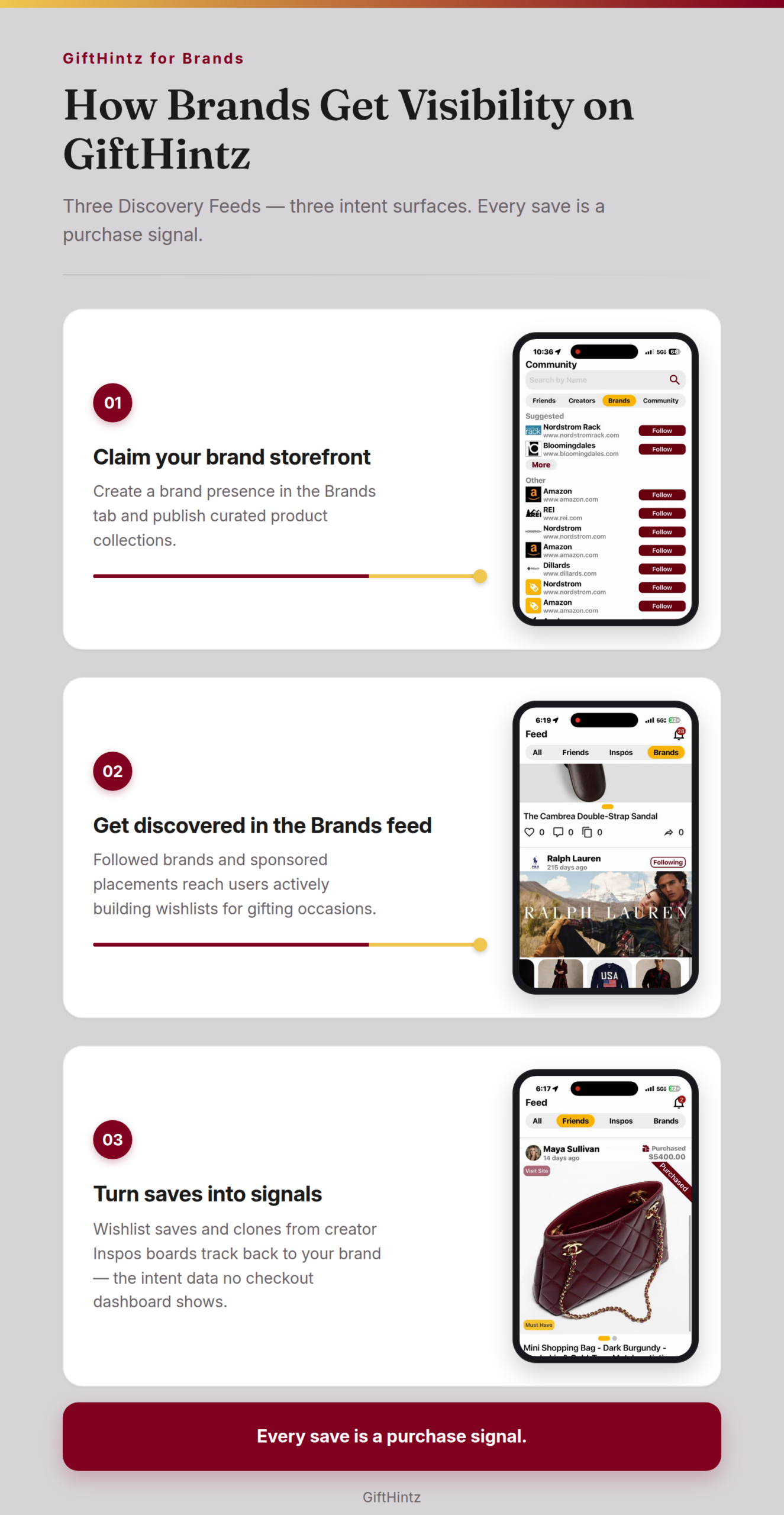
The platform’s three Discovery Feeds — Friends, Inspos, and Brands — function as separate intent surfaces.
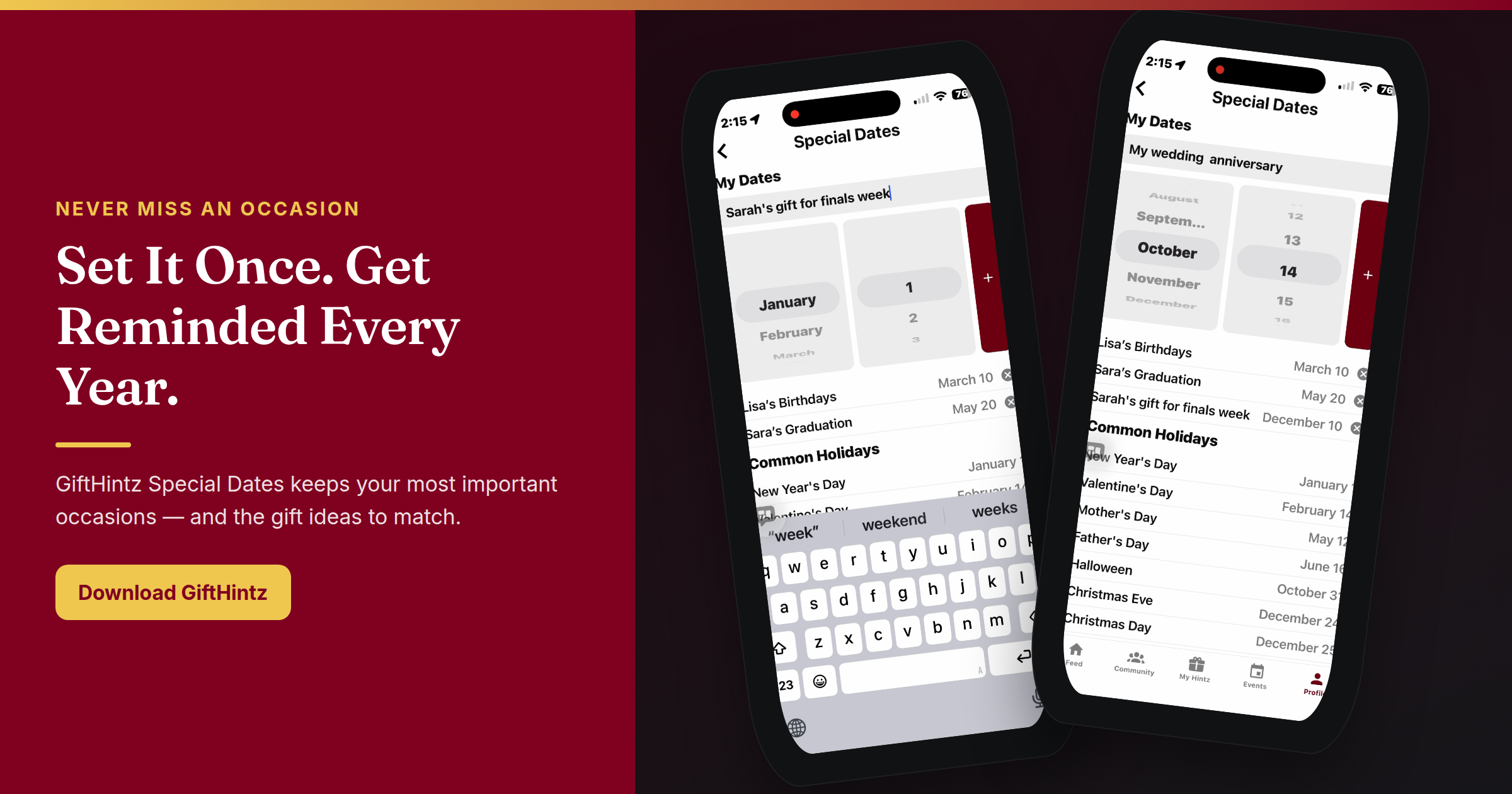
The Brands feed is the direct entry point. Brands on GiftHintz can create a storefront, publish curated product collections, and appear in the Brands feed for users who follow them or browse by category. A user who follows a brand in GiftHintz isn’t a passive audience member — they’re a potential Receiver actively building out their taste profile for an upcoming occasion, or a Giver looking for ideas within a brand they already trust.
Sponsored placements in the Brands feed go further: they surface your products to high-intent users at the exact moment they’re building wishlists for gifting occasions. These aren’t impressions. These are saves — the signal that your product has cleared consideration and entered active deliberation.
The Inspos feed adds a second surface. When a creator builds a board on GiftHintz and a user clones an item to their own wishlist, that attribution follows all the way back to the originating creator — and the brand whose product was featured. Brands whose products appear on creator-built boards get organic distribution that no sponsored post can replicate: a trusted curator’s endorsement, baked into a user’s active wishlist.
The Practical Brand Playbook for 2026
The social commerce landscape in 2026 isn’t a single bet. It’s a portfolio. Here’s how to sequence it:
TikTok Shop: Use it for product discovery and impulse-category inventory. Set aggressive creator affiliate terms for live commerce. Accept that retention will be low; optimize for first purchase.
Pinterest: Invest in product imagery that performs in save contexts — clean, aspirational, titled for the planning mindset. Target seasonal and occasion-based keywords aggressively. Treat saves as a 90-day purchase window.
YouTube: Seed product review creators at every price tier. Long-form content on considered purchases. Track subscription growth as a downstream intent metric.
GiftHintz: Claim your brand presence. Publish a curated storefront. Sponsor a placement in the Brands feed during peak gifting windows (Q4, Valentine’s Day, Mother’s Day). Watch which of your products accumulate wishlist saves — that data tells you which SKUs are gift-worthy and which aren’t. No other platform gives you that signal at this level of specificity.
The brands that own social commerce in 2027 will be the ones who understood in 2026 that the intent signal — not the checkout — is where the real race is run.
Claim your brand presence on GiftHintz and sponsor a placement in the Brands feed to capture wishlist saves while shoppers are still in discovery mode.