Your link-in-bio tool is a graveyard. Fifteen links, zero context, a follower who arrived hot from your last Reel and clicked out in four seconds because nothing was organized around what they actually came to find.
If you’re still routing your audience through a generic link aggregator into a patchwork of affiliate programs, you’re leaving money and influence on the table — not because you lack reach, but because the infrastructure you’re using was built for a different era of the internet. It was never designed for the moment a follower thinks I want what she recommended.
This is the gap shoppable link in bio for creators was supposed to solve. Most tools attempted it. GiftHintz Vibe Boards actually did.
The Real Problem Isn’t the Link Tree — It’s What Comes After
Creator monetization 2025 reality check: you build an audience, apply to LTK or ShopMy, get rejected for not hitting their follower threshold, and end up pasting Amazon affiliate links into a Linktree you haven’t updated since spring. Commission rate: 1–8%. Attribution window: shrinking. If someone screenshots your post and buys later, you earn nothing.
Affiliate fatigue is real — for creators stuck in broken economics and for audiences exhausted by “20% off with my code” posts. The platforms that were supposed to democratize creator commerce built their own gatekeeping on top of the algorithm’s.
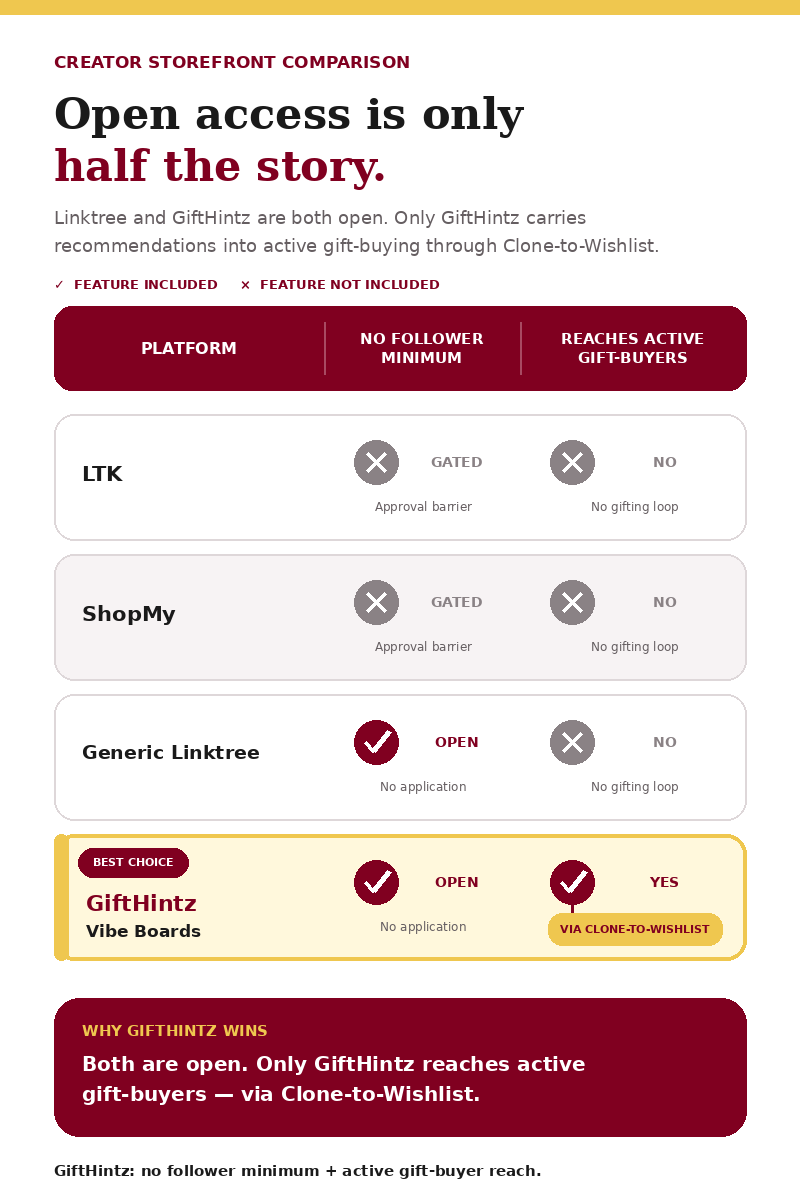
LTK requires approval. ShopMy requires a minimum following. Neither platform has a gifting layer — your audience can discover what you love but has no native way to turn that into a gift for someone else they care about. You’re optimizing for impulse buys, not intent.
What a Vibe Board Actually Does (That a Linktree Can’t)
A GiftHintz Vibe Board is an editorial shoppable collection — visual-first, mobile-first, and built to communicate taste, not just SKUs. Think of it as the difference between a product dump and a curated magazine spread with buy buttons.
The mechanics work in your favor in ways that standard affiliate links don’t:
Any-URL import. You can add products from any retailer — not just Amazon, not just platform partners. If you found it at a small boutique, a DTC brand’s site, or a niche marketplace, it goes on the board. GiftHintz’s AI extraction pipeline captures the product image, title, and price automatically. You’re curating, not copy-pasting.
Clone-to-Wishlist reach. When a follower taps an item on your Vibe Board and clones it to their personal wishlist, your recommendation travels further. That wishlist gets shared with friends and family shopping for gifts — people arriving with genuine purchase intent, not casual scrolling intent. Your source link to the original retailer (Amazon, Shopify, the brand’s site) is embedded in the item from the start. More eyeballs on high-intent wishlists means more downstream clicks on the affiliate links you already control.
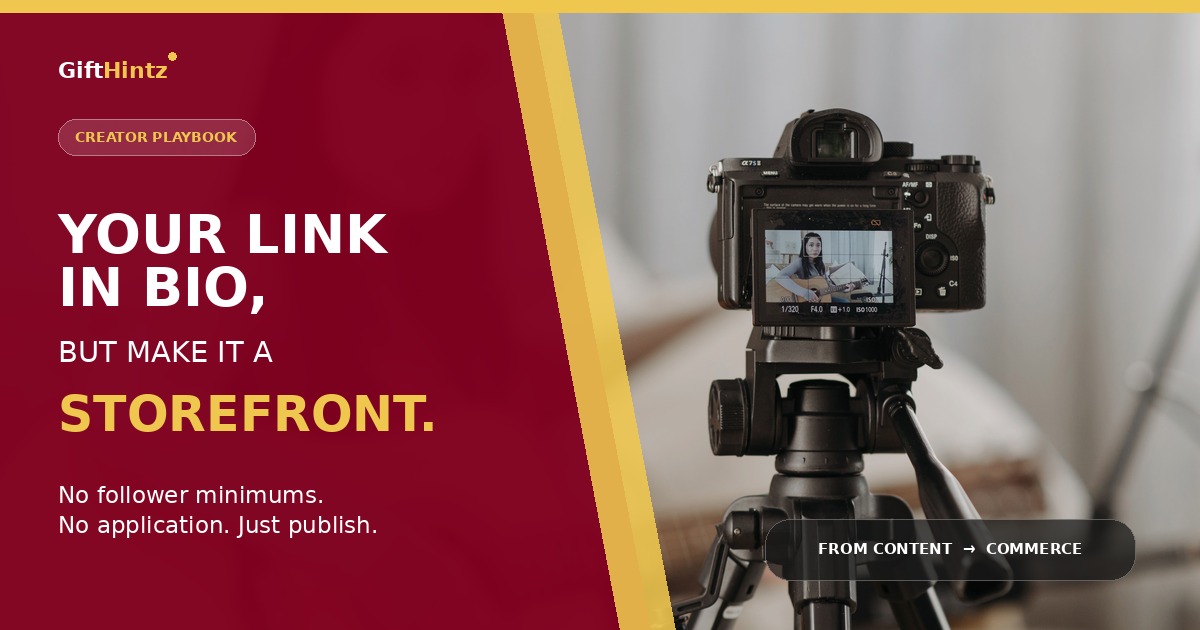
No follower minimum. You don’t apply. You don’t get waitlisted. You build your first Vibe Board and publish it. A micro-creator with 8,000 engaged followers and sharp taste is worth more to the gifting ecosystem than an approved LTK creator posting their fifth blender recommendation of the month.
Building Your First Vibe Board: The 10-Minute Flow
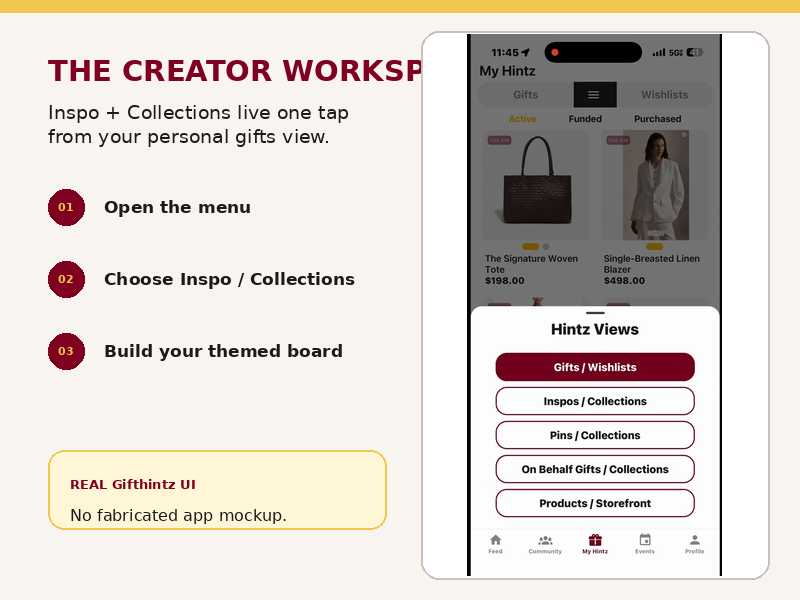
The barrier to entry is deliberately low. Here’s how it works in practice:
Step 1 — Access Inspo and Collections from the menu
Open GiftHintz, tap the three-line menu, and select Inspo and Collections. This is your creator workspace — separate from your personal wishlist, purpose-built for curation.
Step 2 — Create individual Inspo items
An Inspo is a single product recommendation with your context attached. Browse to any retailer page inside the app’s built-in browser, select the product images you want, and GiftHintz scrapes the details automatically. Add a short note about why you’re recommending it — this is the context that converts.
Step 3 — Build the Collection (your Vibe Board)
Once you have a handful of Inspos, group them into a named collection. This is the board your audience sees. Give it a theme that communicates the vibe: “Hostess Gifts Under $75,” “Gifts for the Person Who Has Everything,” “That New Apartment Energy.” Specificity beats breadth every time.
Step 4 — Publish and share
Hit publish. GiftHintz generates a shareable link. Drop it in your bio, your Stories link sticker, your TikTok profile — anywhere your audience expects to find your recommendations. The board is shoppable inline; followers don’t need the app to browse, though cloning to a wishlist requires it.
Step 5 — Share and let it circulate
Every time someone saves an item from your board to their personal wishlist, your recommendation travels into their network. Share your Vibe Board link in your bio, your Stories, your TikTok profile — anywhere your audience lands when they want to buy what you recommend. Each board is a standing asset, not a link that resets every time you update your profile.
How This Works in GiftHintz: The Creator Flow
The creator onboarding on GiftHintz is a live product flow — not a waitlist or a pitch deck. You can open the Inspo and Collections section, create your first item from a product page, and have a published Vibe Board in the same session. The app’s three-line menu puts the creator workspace one tap away from your personal gifts view, keeping curation and personal use in the same ecosystem without conflating the two.
For creators who want to go deeper, the Brand Ambassador path lets you build branded storefronts for specific brands you genuinely partner with — selecting a storefront graphic, naming the collection, and surfacing individual products from that brand’s catalog. It’s the influencer partnership workflow minus the email chains and six-week approval timelines.
The Micro-Creator Storefront Problem Is Solved
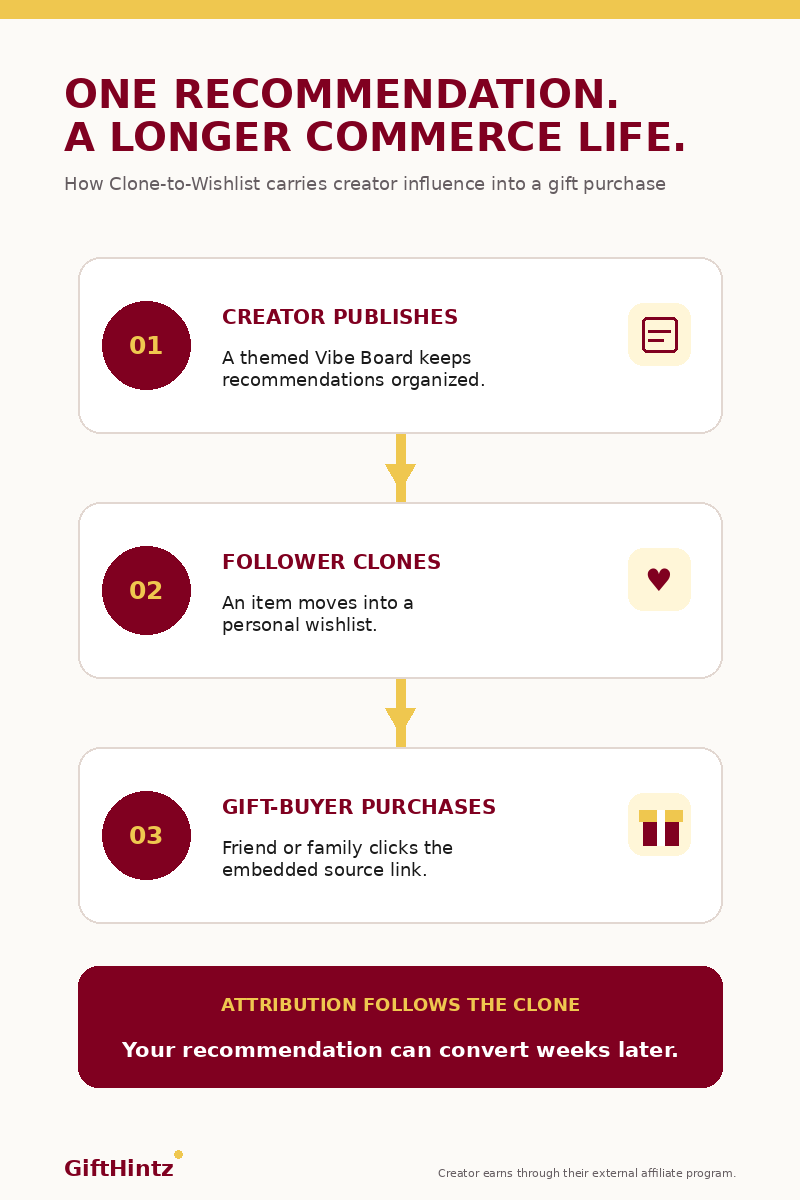
The Clone-to-Wishlist loop means your recommendations circulate through gift-buying decisions you never directly touched. Someone’s mom finds the candle you recommended eight months ago on a wishlist — she clicks through your source link and buys from the retailer. That sale registers in your Amazon Associates account or whichever external affiliate program covers that product.
This is affiliate fatigue-resistant distribution: evergreen boards, high-intent audiences, reach that compounds without extra posting. “Today’s outfit” content has a 48-hour shelf life. A well-named Vibe Board — “Gifts for the Person Who Has Everything” — delivers affiliate clicks through every birthday season.
Related Reading
- Pay for Results, Not Posts: How Closed‑Loop Attribution Is Reshaping Brand‑Creator Deals
- 1,000 True Fans vs. 100K Ghost Followers: The Creator Math That Actually Pays in 2026
- From Awareness to Checkout: How GiftHintz Closes the Loop That TikTok Shop and Instagram Can’t
- Beyond the Cart: Why Wishlist Saves Are the New Gold‑Standard Intent Signal (and How GiftHintz Unlocks Them for Brands)
- Ditch the Gift Card: A Modern Wedding Party’s Guide to Group Gifting (with GiftHintz’s Built‑In Coordination)
Build Your Storefront While the Platform Is Early
GiftHintz is live and open — no application, no follower threshold, no waiting list. The advantage of building now is the same advantage early presence on any platform carries: your Vibe Boards get discovered before the feed is crowded, and the audience you reach is already primed for gifting intent.
Creators in the 5K–150K range on Pinterest, TikTok, and Instagram who aren’t LTK-exclusive have the most to gain. Your affiliate links to Amazon, Shopify, or brand sites travel further embedded in editorial boards designed for gift-buyers — not a generic aggregator page nobody scrolls past the third link.
Build your first Vibe Board, connect your existing affiliate source links, and put your recommendations where gift-buyers are actually looking.