In that moment of hesitation, when your finger hovers over the “purchase” button for a gift intended for a friend’s cultural celebration, the question creeps in: “Is this weird? Am I doing this right?” The desire to participate in a loved one’s tradition is beautiful—a gesture of connection that transcends our differences. Yet that same desire can be accompanied by the fear of missteps, of inadvertently causing offense rather than showing respect.
This spring, as Ramadan, Purim, Holi, Nowruz, and Easter/Passover all converge in a vibrant six-week window of global celebrations, many of us find ourselves wanting to participate in traditions outside our own. The intention is pure: to honor our diverse friendships through meaningful gestures. But the uncertainty can be paralyzing.
What if, instead of that paralysis, we saw this seasonal convergence as an invitation to deepen our connections? What if we had a roadmap for showing up authentically for the people we care about, across cultural boundaries?
This guide is that roadmap—not just for what to give, but for how to give with grace, respect, and genuine warmth. Because the most beautiful gift isn’t just the object itself, but the message it carries: “I see you. I value your traditions. I want to be part of celebrating what matters to you.”
The Universal Language of Gifting: Respect First, Details Second
Before we dive into specific celebrations, let’s establish the foundation of cross-cultural gifting: the intention behind the gesture matters more than perfect execution.
“In cross-cultural exchange, the effort to understand and respect is itself a gift,” explains Dr. Amina Ibrahim, cultural anthropologist and author of Bridges of Tradition. “When someone from outside my faith acknowledges Ramadan with a thoughtful gesture, even if some details aren’t perfect, that acknowledgment itself is meaningful.”
This perspective liberates us from perfectionism. The goal isn’t flawless cultural fluency—it’s showing that you care enough to try. With that foundation in mind, here are the essential principles that apply across traditions:
- Ask questions from a place of curiosity, not assumption. “I’d love to learn more about how you celebrate…” opens doors.
- Research basic do’s and don’ts for specific celebrations, but don’t let the fear of making a mistake prevent participation.
- Consider the timing – some traditions have gift exchanges on specific days of a multi-day celebration.
- When in doubt, consumables (with dietary restrictions in mind) or experience gifts often transcend cultural boundaries.
- A handwritten note expressing what you value about the person and their tradition adds meaning to any gift.
But perhaps the most elegant solution? Let people tell you exactly what would honor their tradition. This is where technology can transform a potential social minefield into a meaningful exchange.
“Creating a GiftHintz wishlist with a note explaining my tradition was a game-changer,” shares Maya Cohen, who celebrates Passover. “Instead of my non-Jewish friends avoiding the holiday because they were afraid of getting something wrong, they could choose something I’d actually love and use during our Seder.”
This approach—creating Wish-Lists with Soul that include notes about the significance of items—eliminates guesswork while preserving the joy of giving. It’s a bridge between cultures built on clarity and care.
Spring Celebrations: A Guide to Meaningful Participation
Let’s explore some of the major celebrations happening in this spring window, with insights on how to participate respectfully. Remember: these are general guidelines, and individual preferences within any tradition will vary.
Ramadan & Eid al-Fitr
The Celebration: Ramadan is the ninth month of the Islamic calendar, observed by Muslims worldwide as a month of fasting, prayer, reflection, and community. It concludes with Eid al-Fitr, a festive breaking of the fast.
Gifting Etiquette:
- Gifts for Ramadan itself are less common, as it’s a period of spiritual reflection. Support during this time might look like accommodating fasting schedules or preparing iftar meals.
- Eid al-Fitr (this year on April 10-11, 2026) is when gift exchanges traditionally occur.
- Traditional gifts include new clothes, money (especially for children, called “Eidi”), home décor, sweet treats, or fragrances.
- Consider halal dietary restrictions when giving food gifts.
Thoughtful Approaches:
- Gift certificates for post-sunset meals during Ramadan can be a thoughtful gesture.
- Dates are traditionally used to break the fast and make a meaningful gift.
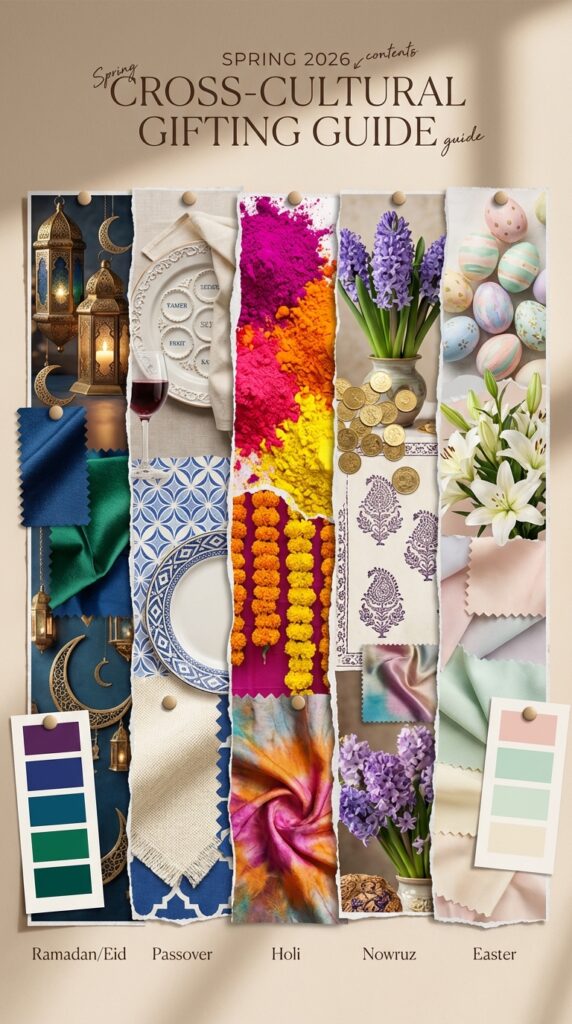
- Decorative lanterns (fanous) are associated with Ramadan in many cultures.
- For Eid, gifts that help create a festive atmosphere for family gatherings are appreciated.
GiftHintz Integration: Ask Muslim friends to create a “Ramadan Essentials” or “Eid Celebration” Collection on GiftHintz, where they can include items that would be meaningful for their specific observance, along with notes about their significance. This transforms potentially awkward questions into an invited learning experience.
Passover
The Celebration: Passover (April 14-22, 2026) commemorates the liberation of Israelites from Egyptian slavery. The heart of the celebration is the Seder, a ritual meal where the story of Exodus is retold.
Gifting Etiquette:
- Kosher for Passover food gifts require special certification, as many regular kosher items aren’t permitted during this holiday.
- Wine is traditional for Passover, but ensure it’s kosher for Passover.
- Gifts that enhance the Seder experience are particularly thoughtful.
- Practical items for hosting (serving platters, matzah covers, etc.) are appreciated.
Thoughtful Approaches:
- Kosher for Passover chocolates or macaroons from a reputable bakery.
- A beautiful Seder plate or Elijah’s cup if you know they don’t already have one.
- A cookbook focusing on Passover recipes.
- Flowers or non-food items avoid the complexity of Passover food restrictions.
GiftHintz Integration: Encourage friends celebrating Passover to create a “Seder Essentials” Collection, which could include both traditional items they need and modern interpretations they prefer. This eliminates the guesswork around kosher requirements while still allowing for personalized participation.
Holi
The Celebration: Holi (celebrated March 14, 2026) is known as the Festival of Colors or the Festival of Love. This ancient Hindu festival celebrates the triumph of good over evil and the arrival of spring.
Gifting Etiquette:
- Traditional gifts include sweet treats like gujiya or mathri, dry fruits, or trinkets.
- Colors (gulal) for the celebration make practical gifts before the festival.
- Gifts that help with post-Holi skin and hair care are thoughtful.
- Items for home refreshment align with the spring renewal aspect of Holi.
Thoughtful Approaches:
- Natural, skin-safe colors if giving gulal.
- A gift basket with sweet treats and dry fruits.
- Herbal skincare products for after the celebration.
- Flowering plants to represent spring’s arrival.
GiftHintz Integration: A “Holi Celebration” Collection could include both items for the festival itself and the post-celebration refresh, allowing friends to select according to their specific needs and traditions.
Nowruz (Persian New Year)
The Celebration: Nowruz (March 20, 2026) marks the beginning of spring and the Persian New Year. It’s celebrated across many countries including Iran, Afghanistan, Kurdish regions, and Central Asian nations.
Gifting Etiquette:
- New clothes, books, or gold coins are traditional gifts.
- Foods representing sweetness and prosperity for the new year are welcome.
- Flowers, especially hyacinths or tulips, symbolize renewal.
- Gifts for the home are appropriate as spring cleaning precedes the celebration.
Thoughtful Approaches:
- Poetry books, especially works by Persian poets like Hafez or Rumi.
- Items for the Haft-Seen table, a traditional arrangement of seven symbolic items.
- Homemade sweets like baklava or Persian pastries.
- Gift cards to favorite restaurants or experiences to enjoy in the new year.
GiftHintz Integration: A Nowruz-specific Collection could help friends share not just what items they’d appreciate, but also the cultural significance behind them, creating an educational exchange alongside the gifting process.
Easter
The Celebration: Easter (April 5, 2026) celebrates the resurrection of Jesus Christ in the Christian faith. It’s also associated with spring renewal themes.
Gifting Etiquette:
- Religious items are appropriate for those who observe the spiritual aspects.
- Chocolate eggs, bunnies, and spring-themed gifts are common secular exchanges.
- Easter baskets for children are traditional in many Western countries.
- Flowers, especially lilies, have Easter associations.
Thoughtful Approaches:
- Artisanal chocolates or baked goods.
- Spring-themed home décor or garden items.
- Religious items like crosses or prayer books for devout observers.
- Experience gifts for Easter Sunday or the spring season.
GiftHintz Integration: Easter Collections can reflect the wide spectrum of how people celebrate—from deeply religious observances to secular spring celebrations—allowing gift-givers to select items that align with the recipient’s personal approach.
When Celebrations Converge: The Gift of Understanding
This spring’s convergence of global celebrations offers a unique opportunity to deepen cross-cultural understanding through thoughtful exchange. But navigating multiple traditions can be overwhelming.
“The anxiety about ‘getting it wrong’ often prevents meaningful cross-cultural connection,” notes Rabbi Sarah Levine. “But the alternative—not acknowledging a friend’s important celebration—can feel like erasure. What we need are bridges that allow respectful participation.”
GiftHintz Wish-Lists with Soul provide exactly that bridge. By inviting people to share not just what they want, but why it matters to their tradition, these digital collections transform potential awkwardness into invited participation.
The platform’s approach is elegantly simple:
- Create a celebration-specific Collection with notes about the tradition’s significance
- Share it with friends from different backgrounds who’ve expressed interest in participating
- Include personal context about how you observe the tradition
- Add options at various price points to accommodate different comfort levels
This system honors both the giver’s intention to connect and the receiver’s role as the authority on their own tradition. It transforms “Is it weird if I…?” into “I’m so glad you showed me how to participate.”
Beyond Objects: The Gift of Presence
While material gifts can be meaningful expressions of cross-cultural respect, sometimes the most profound gift is simply showing up—with humility, curiosity, and a willingness to learn.
“Being invited to my colleague’s Nowruz celebration was life-changing,” shares Michael Chen. “I was nervous about making a mistake, but she created a GiftHintz Collection that included not just gift ideas but also notes about appropriate attire, traditional greetings, and what to expect. It transformed my anxiety into anticipation.”
This approach—using technology to facilitate deeper human connection—represents the future of cross-cultural exchange. It’s not about perfect execution of traditions; it’s about perfect intention in building bridges.
When you receive an invitation to participate in a cultural celebration different from your own, consider it a profound honor. Someone is inviting you into their heritage, their family stories, their sacred spaces. Respond with gratitude, curiosity, and the humility to learn.
And when you want to honor someone else’s tradition? Start by inviting them to share a GiftHintz wishlist with explanatory notes. This simple request communicates volumes: “I value your tradition enough to want to participate correctly. I respect you as the authority on your own culture. I want to learn, not assume.”
In this exchange—this mutual honoring of difference and discovery of commonality—we find the true gift: a world where diverse traditions don’t divide us but enrich us, where crossing cultural boundaries becomes an act not of transgression but of celebration.
Your Cross-Cultural Gifting Checklist
As this season of global celebrations unfolds, consider this your practical guide to meaningful participation:
- Invite sharing through technology: Ask friends celebrating traditions different from yours to share their GiftHintz wishlist with a note explaining the significance.
- Approach with humble curiosity: Frame your participation as an opportunity to learn, not an obligation to perform perfectly.
- Honor timing and context: Research when gifts are traditionally exchanged within multi-day celebrations.
- Consider dietary and religious restrictions: Especially important for food gifts or items with religious symbolism.
- Include a personal note: Express what you value about the person and their cultural heritage.
- Reciprocate the invitation: Share your own traditions by creating celebration-specific Collections with explanatory notes.
- Value presence over presents: Sometimes participating in a celebration is more meaningful than bringing a gift.
The beauty of cross-cultural exchange lies not in flawless execution but in genuine connection—in those moments when we reach across differences to say, “I see you. I honor what matters to you. I want to be part of this celebration.”
In a world that often emphasizes our divisions, these intentional acts of cultural bridge-building become revolutionary. They remind us that human connection transcends boundaries—that we can be both proudly rooted in our own traditions and genuinely curious about others’.
Share your GiftHintz wishlist with a note explaining your tradition—friends from any background can find the perfect gift without guessing. Then, extend the invitation to learn about their celebrations too. In this exchange, we discover the most meaningful gift of all: a world where differences aren’t barriers but invitations to connect.