Every December, the same ritual plays out. You’re racing through crowded stores or doom-scrolling product pages at midnight, settling for gift cards because everything meaningful is out of stock or won’t arrive in time. It’s not that you don’t care — it’s that the system wasn’t built for people who do.
Early holiday gifting in late summer changes that equation entirely. And if you’ve been wondering whether starting your holiday planning in August or September is too soon, the data says you’re already late.
Why Early Holiday Gift Planning Is the New Normal
Consumer behavior data from 2025 showed that 34% of U.S. shoppers started holiday gift purchases before October — up from 23% just three years prior. Inflation anxiety and supply chain memories pushed people to lock in gifts while stock and prices were predictable. That trend has only deepened in 2026. Gift-giving preferences are also shifting — see how aesthetic-coded gifting is winning this year.
But here’s what the data doesn’t capture: the emotional payoff. There’s a real difference between a gift you bought with intention three months out and something you grabbed in desperation on December 22nd. Recipients feel that difference, even if they can’t name it.
The early planners aren’t just buying earlier — they’re thinking better. They’re matching gifts to the person, not to the deadline.
The 4-Month Holiday Gifting Timeline
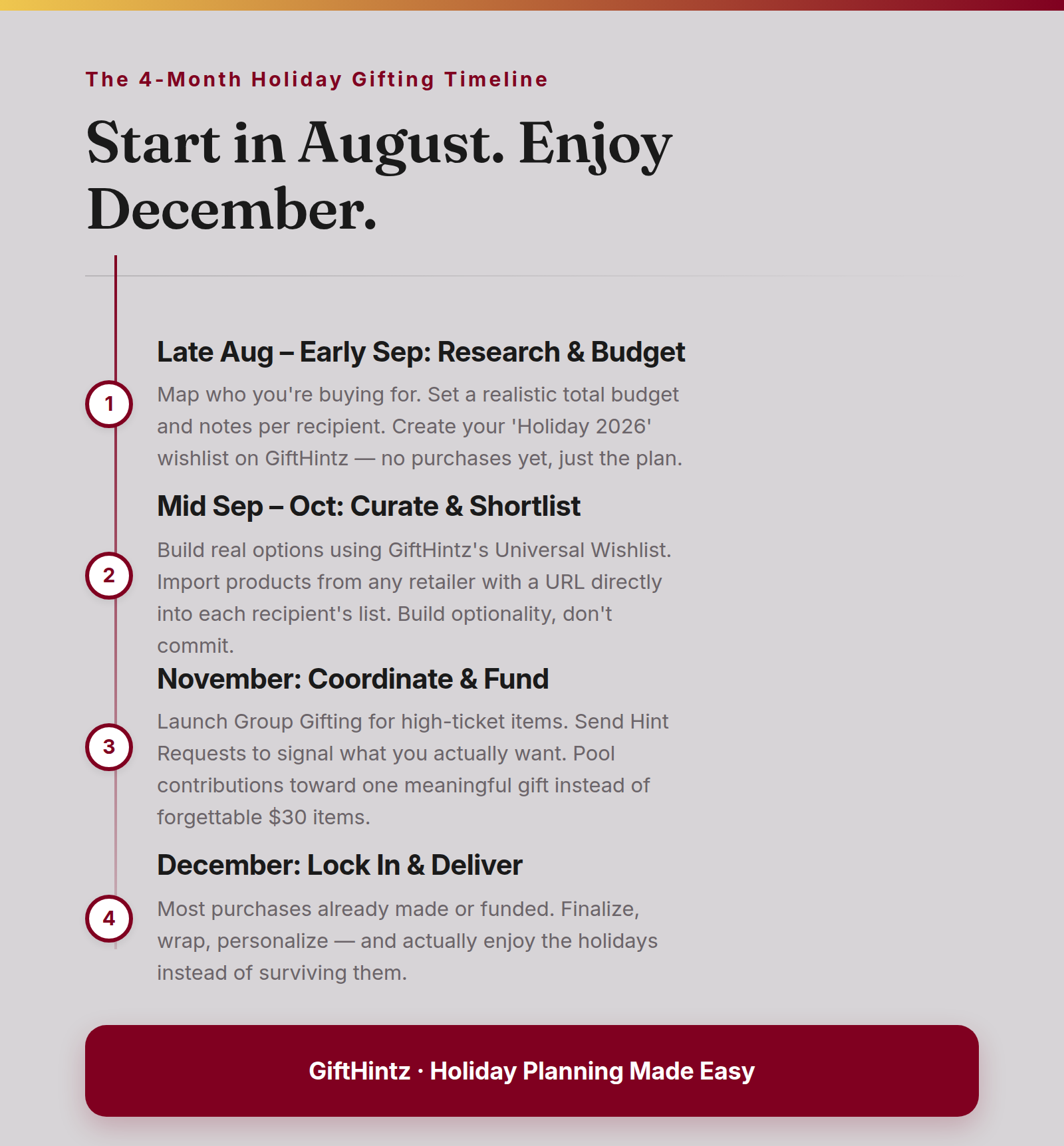
Getting ahead of the holidays doesn’t mean buying everything at once in August. It means spreading out the cognitive and financial load across a sensible window. Here’s a framework that works:
Late August – Early September: Research and budget
This is the time to take stock. How many people are you buying for? What’s your realistic total budget? What did last year’s gifts land like? No purchases yet — just mapping.
Start a dedicated "Holiday 2026" wishlist on GiftHintz. Organize it by recipient, and for each person, set a budget ceiling and a few notes about what they’re into right now. This becomes your master plan document.
Mid-September – October: Curate and shortlist
Once you know who you’re buying for and what you’re working with, start pulling real options together. GiftHintz’s Universal Wishlist lets you import products from any retailer with a URL — so when you see something on Etsy, a boutique site, or a brand you love, you can save it directly to the right recipient’s list in seconds.
This phase is about building optionality, not committing. You’re not buying yet — you’re giving yourself better choices.
November: Coordinate and fund
This is where gift coordination gets real. For big-ticket items — a cashmere coat, a weekend experience, a piece of tech — this is the moment to bring in the group. GiftHintz’s Group Gifting feature lets family members pool contributions toward one meaningful item instead of each person spending $30 on something forgettable.
Use GiftHintz’s Hint Request to signal what you actually want — or to ask the people on your list what’s on theirs. A well-timed hint eliminates the guesswork that leads to returns, re-gifting, and box-closet purgatory.
How This Works in GiftHintz
The most powerful part of GiftHintz for early planners isn’t any single feature — it’s the flow between them.
You open the app, navigate to Wishlists, and create a new one called "Holiday 2026." Give it a banner and a clear structure, broken out by recipient or budget tier. From there, any time you spot something on a website, in an Instagram post, or on TikTok, you can share it directly into your GiftHintz list — the app extracts the product details automatically.
When you’re ready to coordinate with others, you publish the wishlist and send hint links to the people who’ll be buying for you. They arrive at a curated list that tells them exactly what you want, in the price range they can work with. No awkward conversations. No "just get me anything" texts.
For the high-value items, enable Group Gifting on those specific gifts. Family members can contribute what they’re comfortable with — $25, $50, $200 — and GiftHintz tracks progress and handles the coordination so you don’t have to.
December: Lock in and deliver
By the time December arrives, most purchases should already be made or funded. The final month is for wrapping, personalizing, and actually enjoying the holidays — instead of surviving them.
The Real Benefit: Budget Sanity
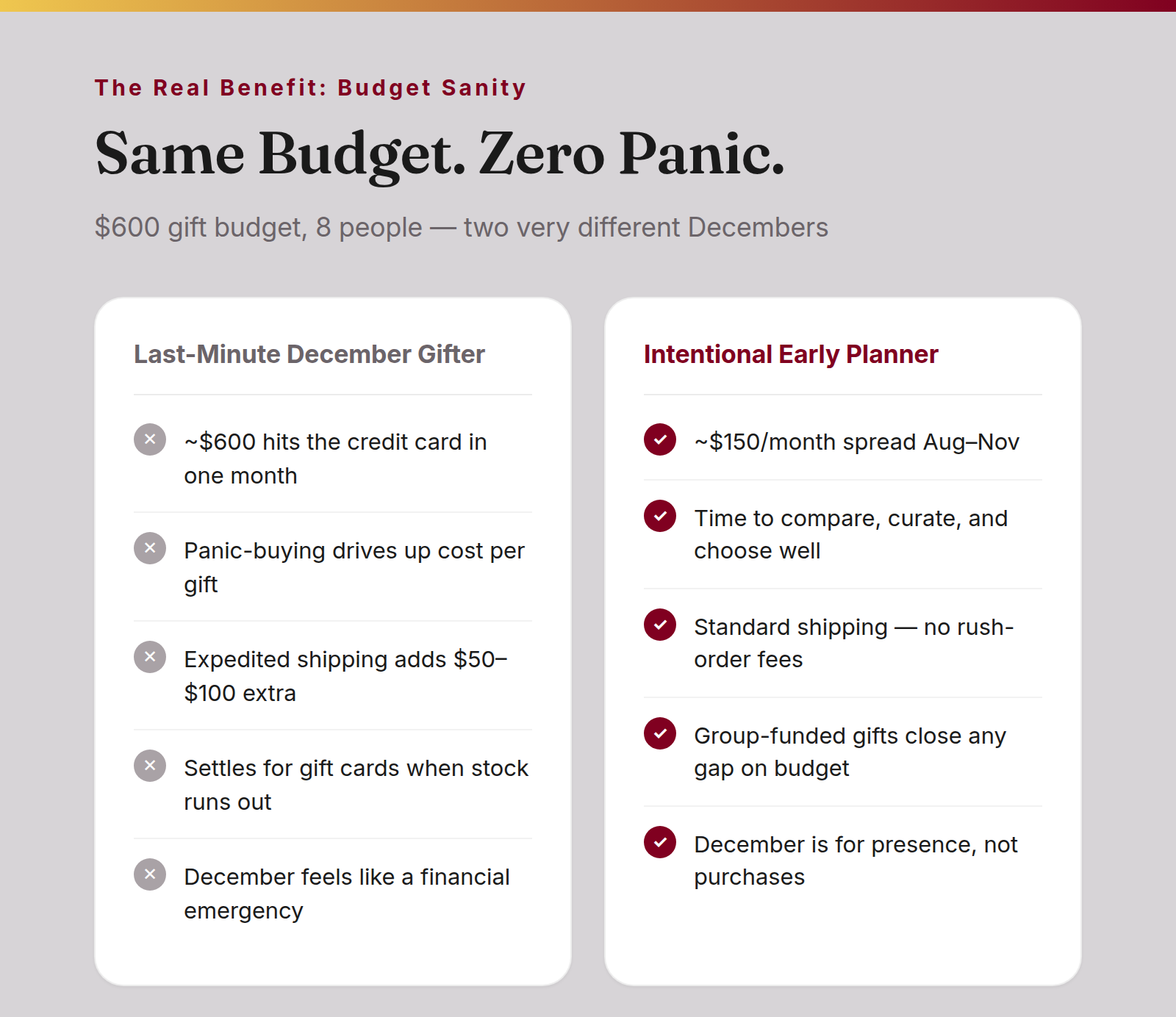
One underrated advantage of early planning is how it affects your spending. When you’re buying gifts across four months instead of four weeks, the financial strain flattens out. You’re not making panicked bulk purchases. You’re not paying for expedited shipping because the regular option won’t make it in time.
If your holiday gift budget is $600 across eight people, spreading those purchases between August and November means roughly $150 a month — not a $600 hit to your December credit card statement.
GiftHintz’s structure helps with this too. When you assign budgets per recipient inside your wishlist, you can see at a glance where you’re ahead, where you’re behind, and where a group-funded gift will close the gap without blowing your ceiling.
Stop Treating December as the Starting Line
The gifters who make the most impact aren’t the ones who spent the most. They’re the ones who thought the most — and gave themselves enough time to act on it.
Starting your holiday gift planning in late summer isn’t obsessive. It’s the sanest thing you can do for your relationships, your budget, and your December self. By September, you’ll have a plan. By November, you’ll have most of it handled. By December, you’ll actually be present.
Start your Holiday 2026 wishlist on GiftHintz today, organize it by recipient and budget, and share hint links before the holiday rush begins.