Pay for Results, Not Posts: How Closed-Loop Attribution Is Reshaping Brand-Creator Deals
In 2026, brands aren’t paying for pretty pictures anymore. They’re paying for provable sales. The creator economy’s feel-good era is over. Welcome to the age of accountability.
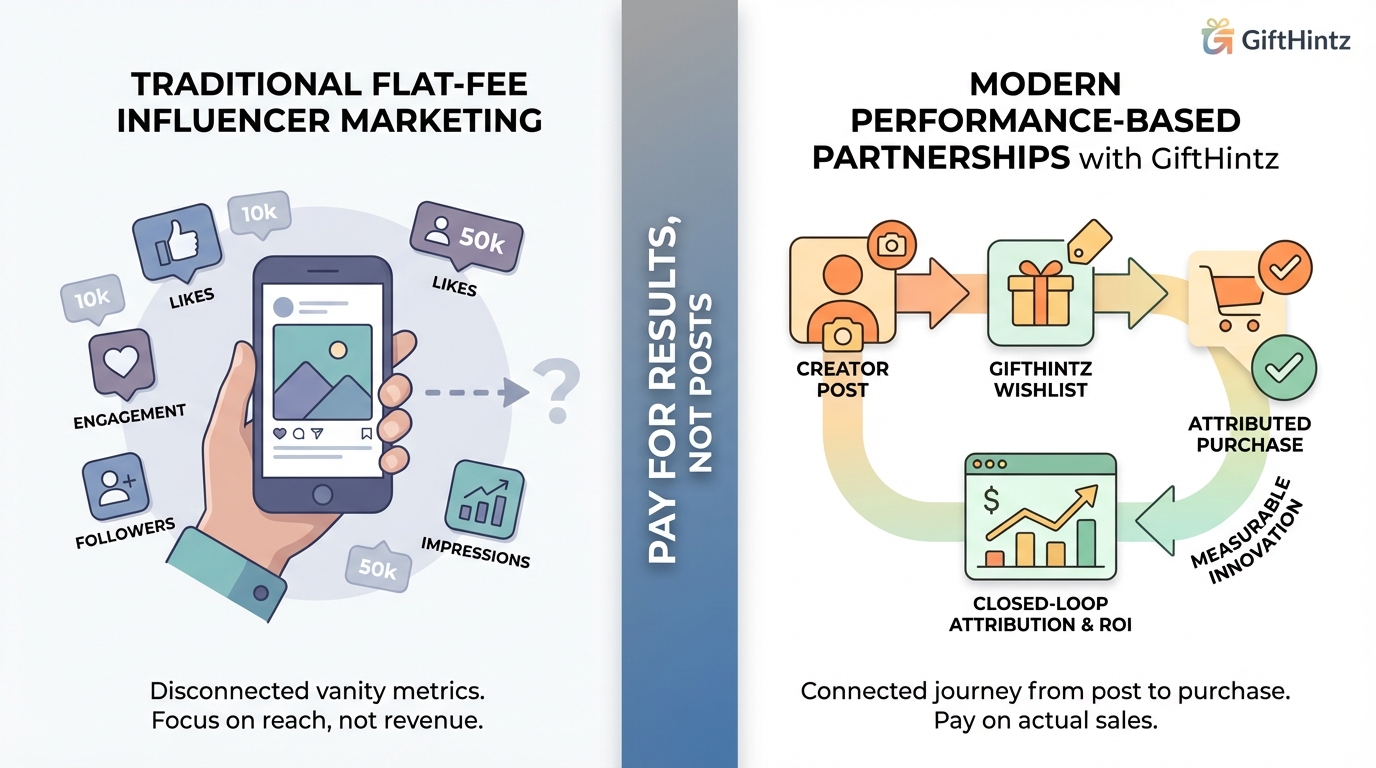
Impact.com’s 2026 influencer marketing report reveals what savvy brands already know: flat-fee creator deals are dying. Performance-based and revenue-sharing models are taking their place. Collabstr’s latest data confirms it. The shift isn’t coming—it’s here.
But there’s a problem: attribution is a mess.
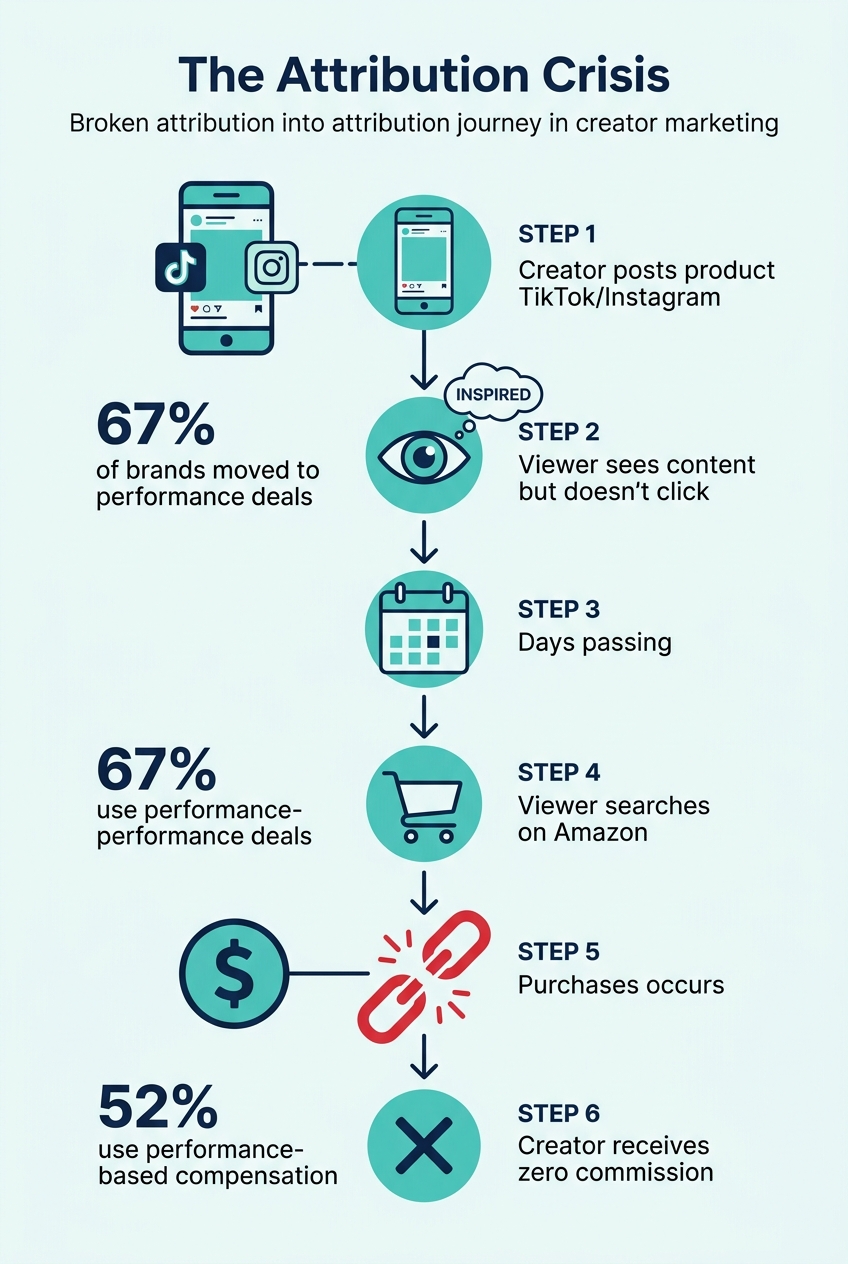
A creator posts on TikTok. Three days later, their viewer buys on Amazon. Who gets credit? The platform? The creator? The last-click affiliate link? This broken system means creators lose commissions they’ve earned and brands can’t track what’s actually working.
Until now.
The Attribution Crisis No One’s Solving
Traditional influencer deals suffer from a fundamental flaw: disconnection. The journey from inspiration to purchase happens across multiple platforms, browsers, and days. This fragmentation creates blind spots that prevent accurate tracking.
Here’s what happens:
- Creator posts product on TikTok or Instagram
- Viewer gets inspired but doesn’t click immediately
- Days later, viewer searches for product on Amazon
- Purchase happens with zero attribution to the creator
- Creator loses earned commission
- Brand loses data on which creators drive sales
The standard solutions—UTM codes, affiliate links, coupon codes—all require the viewer to take specific actions that break their natural behavior pattern. They work sometimes, not always.
This broken system means brands overpay for underperforming creators while the truly effective ones are undervalued. It also means brands are making decisions based on incomplete data, essentially flying blind with their creator marketing budgets.
The Industry Shift to Performance-Based Compensation
According to Impact.com’s 2026 influencer marketing report, there’s been a dramatic shift in how brands structure creator deals:
- 67% of brands have moved away from flat-fee payments
- 52% now offer some form of performance-based compensation
- 41% have implemented revenue-sharing models
- Only 22% still rely primarily on flat-fee structures
Collabstr’s 2026 creator economy report shows similar trends, with 58% of creators reporting they now earn more from performance-based deals than from flat fees—a complete reversal from 2024 figures.
This shift benefits both sides when implemented correctly:
For brands:
- Lower upfront costs and reduced financial risk
- Better ROI accountability and measurement
- Alignment of creator incentives with business goals
- Stronger partnerships with creators who can deliver results
For creators:
- Potentially higher earnings with no ceiling
- Multiple revenue streams from the same content
- Long-term passive income from evergreen content
- Rewards for quality over quantity
The problem isn’t the payment model—it’s the infrastructure. Most platforms simply can’t track the full funnel in a way that’s fair to creators and transparent to brands. They’re building performance-based payment systems on fundamentally broken attribution models.
Closed-Loop Attribution: The Missing Piece
What does true closed-loop attribution look like in creator marketing? It means being able to trace every purchase back to its point of inspiration, even if:
- The purchase happens days or weeks later
- The buyer uses a different device or platform
- No affiliate link or coupon code is used
- Multiple touchpoints influence the decision
Most systems fail at one or more of these criteria. They fragment at precisely the points where consumer behavior is most natural. A viewer shouldn’t have to remember a coupon code or click a specific link for a creator to get credit for driving a sale.
The current attribution landscape is fragmented:
- Instagram Shop — In-platform tracking only. Loses attribution once user leaves the app.
- TikTok Shop — Platform-specific pixels. Cannot track cross-device journeys.
- LTK — App-specific tracking. Limited to purchases through their ecosystem.
- Amazon Influencer — Last-click attribution. Creators lose credit if purchase happens later.
- Traditional Affiliates — Cookie-based tracking. Subject to privacy restrictions and cookie deletion.
These disconnected systems create an adversarial relationship between brands and creators. When attribution is fuzzy, trust erodes. Brands question whether they’re getting value, and creators wonder if they’re being credited for the sales they generate.
The solution isn’t another bolt-on tracking system—it’s a platform built from the ground up to connect every dot in the purchase journey.
GiftHintz Clone Attribution: The Full-Funnel Solution
GiftHintz approaches the attribution problem differently. Instead of retrofitting tracking onto existing behavior, it creates a natural path from inspiration to purchase where attribution is built in at every step.
Here’s how the closed-loop system works:
- Creation: Creator builds a Vibe Board with curated products
- Inspiration: Follower discovers products through the creator’s board
- Intention: Follower clones items to their personal wishlist with one tap
- Transaction: Gifter purchases directly from that wishlist
- Attribution: Creator earns commission on the sale, with full tracking at each step
This model succeeds where others fail because it doesn’t force unnatural behavior. The attribution is inherent in the platform architecture—not dependent on links, cookies, or codes that can break.
For brands, this means:
- Precise tracking of which creators drive actual sales
- Clear ROI measurement for every creator partnership
- The ability to optimize budgets based on performance data
- Confidence in performance-based payment models
For creators:
- Fair credit for driving purchase intent
- Commission on sales even if they happen days later
- Clear performance metrics to prove their value to brands
- The ability to optimize content based on what actually converts
Implementing Performance-Based Creator Partnerships
For brands ready to shift to performance-based creator deals, here’s how to structure partnerships that actually work:
1. Define Clear Success Metrics
Begin with precise, measurable goals:
- Sales volume (units or revenue)
- New customer acquisition
- Wishlist additions
- Engagement quality over quantity
2. Create a Fair Compensation Structure
The best performance-based deals include:
- Base payment to cover content creation costs
- Tiered commission structure that rewards performance
- Bonuses for exceeding targets
- Long-term attribution window (60-90 days minimum)
3. Ensure Your Attribution System Is Truly Closed-Loop
Your platform must be able to:
- Track across the entire funnel
- Connect content views to actual purchases
- Account for multi-touch attribution
- Provide transparent reporting to both brand and creator
4. Focus on Long-Term Creator Relationships
Performance-based doesn’t mean transactional:
- Invest in creator education and onboarding
- Share performance data and insights
- Collaborate on strategy refinement
- Create incentives for ongoing promotion
Case Study: Brand Success with Closed-Loop Attribution
A premium homeware brand shifted from traditional flat-fee influencer deals to performance-based partnerships on GiftHintz. The results after one quarter:
- 42% reduction in upfront creator costs
- 137% increase in attributable sales from creator content
- 23% higher average order value on creator-driven purchases
- 4.8x ROI compared to 2.1x with their previous program
The key difference wasn’t just the payment structure—it was the attribution model. With GiftHintz’s clone attribution, the brand could see exactly which creators, which products, and which content styles drove actual revenue.
This complete visibility allowed them to:
- Double down on high-performing creators
- Refine their product selection for creator partnerships
- Adjust commission rates based on actual performance
- Demonstrate clear ROI to leadership, securing bigger budgets
Perhaps most importantly, their creator relationships improved. Instead of contentious negotiations about flat fees based on follower counts, conversations focused on shared success metrics and strategic collaboration.
The Future of Creator Economics Is Already Here
The shift to performance-based creator deals isn’t just a trend—it’s the correction the market needed. The initial creator economy boom was built on proxy metrics: followers, likes, views. The mature creator economy is built on business outcomes: sales, customers, revenue.
For this evolution to succeed, platforms need to solve the attribution problem. Without accurate, full-funnel tracking, performance-based models can actually undervalue creators by failing to credit them for the sales they influence.
This is where GiftHintz’s approach represents the future: a system where every step from discovery to purchase is connected, where creators get credit for the full value they create, and where brands can confidently invest in performance-based partnerships.
In this new landscape, the relationship between brands and creators transforms from transactional to truly collaborative. Both parties are aligned around the same goal—driving meaningful consumer action—and both have complete visibility into what’s working.
What This Means For Your 2026 Creator Strategy
As performance-based creator deals become the norm, brands need to rethink their approach:
- Evaluate your attribution infrastructure — Can your current system track the complete path from creator content to purchase? If not, you’re likely undervaluing your best creators.
- Shift from quantity to quality metrics — Move beyond reach and engagement to focus on wishlist adds, purchase intent signals, and actual conversion.
- Develop fair, transparent creator contracts — Create compensation structures that protect creators while rewarding performance.
- Choose platforms that enable true closed-loop tracking — Without this foundation, performance-based deals won’t reach their potential.
The brands that will win in this new paradigm aren’t just changing how they pay creators—they’re changing how they measure success, how they structure partnerships, and which platforms they prioritize.
Partner with GiftHintz Creators Using Performance-Based Commission
GiftHintz offers the attribution layer brands need to make performance-based creator deals work. Our clone attribution tracks every step from inspiration to purchase, so you only pay for real results.
With GiftHintz, you can:
- Launch performance-based creator campaigns with built-in attribution
- Track exactly which creators drive wishlist adds and purchases
- See which products perform best across your creator network
- Optimize your creator investments based on actual sales data
- Build long-term creator relationships based on shared success
The future of creator partnerships isn’t just paying for results—it’s having the infrastructure to accurately measure those results in the first place. GiftHintz provides both the performance-based payment framework and the closed-loop attribution system to make it work.