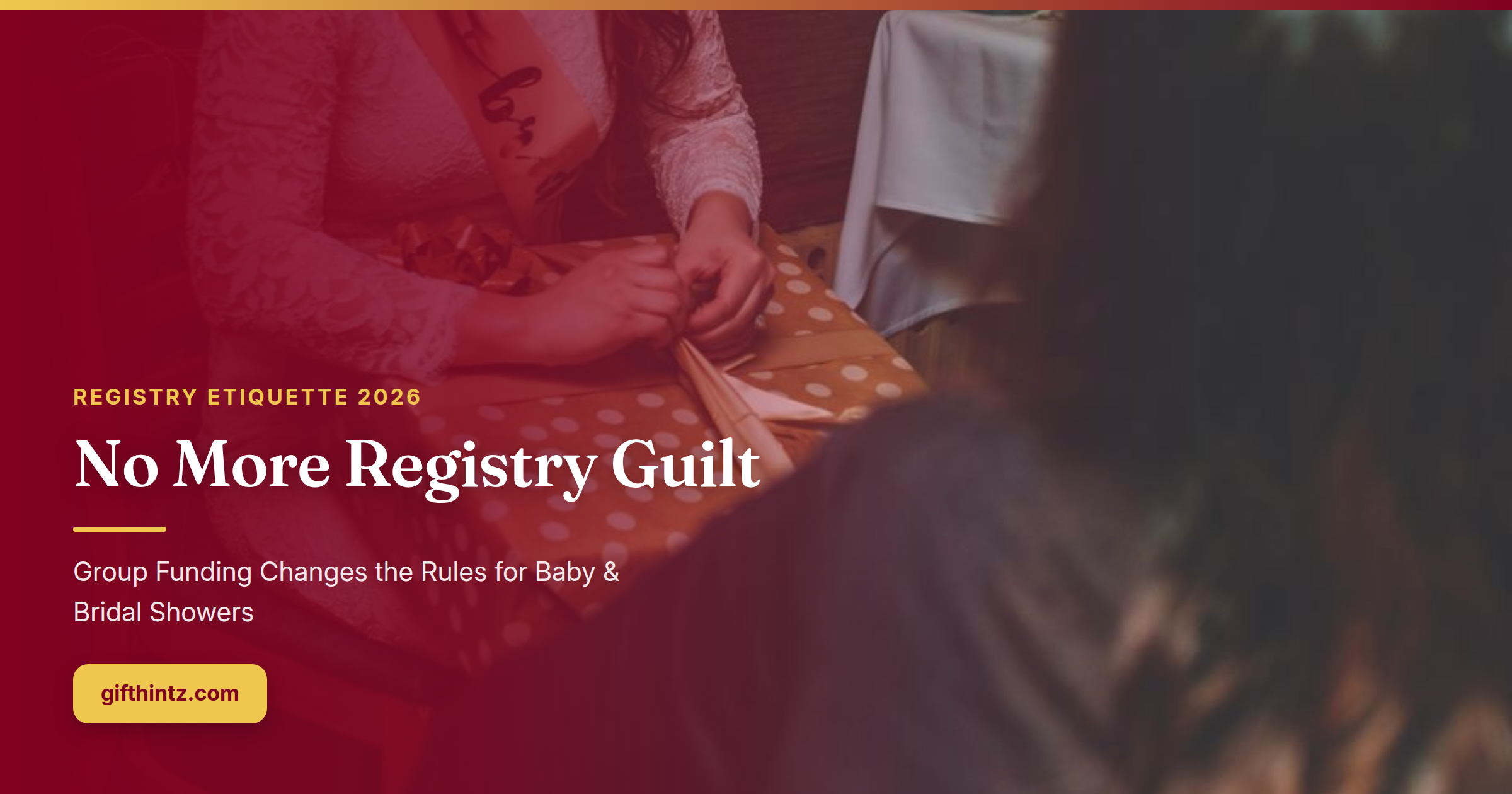
The group-chat spiral around baby shower group gifting etiquette is predictable: someone drops a screenshot of the $1,200 stroller in the registry. One person Venmos $40 without telling anyone. A second says they were going to do the changing table. A third goes silent for three days, then buys the burp cloths as a safe fallback. Nobody knew what anyone else was doing, the guest of honor got four of one thing and none of another, and everyone walked away mildly annoyed at a process that was supposed to be joyful.
This is not a people problem. It’s a tools problem.
Why Registry Etiquette Needed a Reset
The traditional shower registry was built on one assumption: every guest buys a solo gift within a comfortable price range. That assumption created two problems nobody addressed out loud.
First, hosts felt guilty listing big-ticket essentials. You’d load the $30 swaddle set and the $18 onesie pack so you didn’t look presumptuous. Then you’d privately hope someone generous would grab the stroller — and they often wouldn’t, because a $900 item felt too large to commit to solo.
Second, guests with limited budgets felt the squeeze. If the registry skewed expensive, you’d either stretch beyond your comfort zone or grab the last onesie pack (after three others already bought it) and feel like you showed up underprepared.
Group funding breaks both of those loops — but only when the tools exist to run it cleanly.
Baby Shower Group Gifting Etiquette in 2026: The Three-Tier Registry
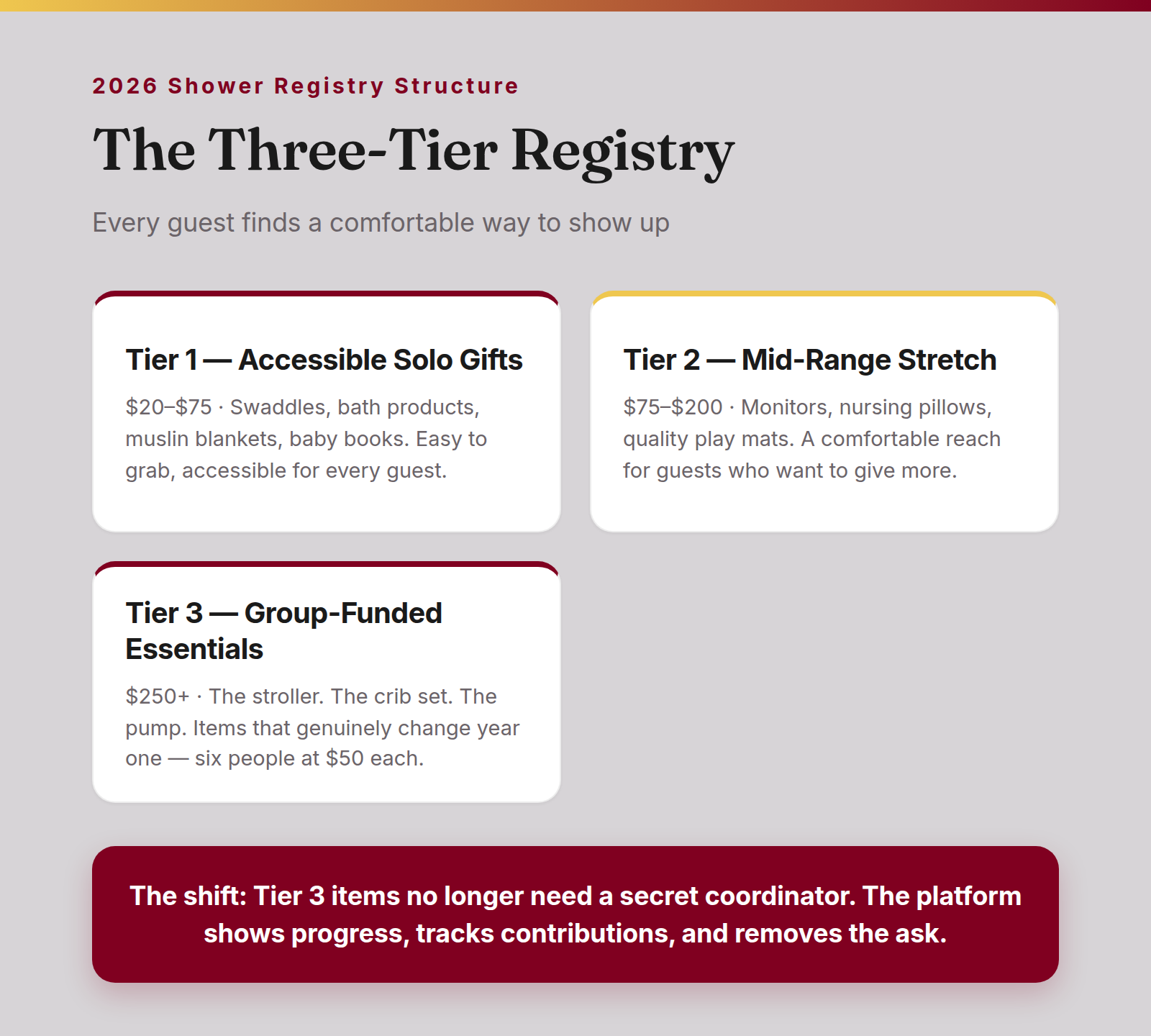
The new etiquette isn’t complicated. A well-structured 2026 shower registry has three tiers:
Tier 1 — Accessible solo gifts ($20–$75): Swaddles, bath products, muslin blankets, baby books. Easy to grab, easy to wrap, accessible for every guest regardless of budget.
Tier 2 — Mid-range stretch ($75–$200): Monitors, quality nursing pillows, a solid play mat. A comfortable reach for guests who want to give something more substantial.
Tier 3 — Group-funded essentials ($250+): The stroller. The crib set. The hospital-grade breast pump. Items that genuinely change the first year and that make no sense to buy solo when six people would happily contribute $50 each.
The shift in registry etiquette without guilt is this: Tier 3 items no longer need a secret coordinator running a Google Form. They need a platform where guests can contribute any amount, see who else has pitched in, and know it’s tracked without anyone having to ask twice.
The Bridal Shower Version Has the Same Problem, Different Flavor
Everything above applies to bridal showers — with one twist. Registry culture around weddings carries more social weight, which means the guilt goes both directions.
Historically, bridal shower registries and wedding registries were treated as two separate artifacts — the shower for small, fun gifts; the wedding for the real list. In 2026, that line is blurring. Hosts building bridal shower events now link directly to a shared registry that includes both accessible items and group-funded experiences: a wine subscription, a spa day, honeymoon fund contributions, a cooking class for two.
Bridal shower registry tips for 2026: lead with experiences. They’re natural candidates for pooled contributions, and guests feel good participating in something that creates a memory rather than adding to a kitchen cabinet. The best setups function as a universal baby registry equivalent for bridal occasions — no store-locking, no forced platform, products saved from anywhere your guest of honor actually shops.
How This Works in GiftHintz
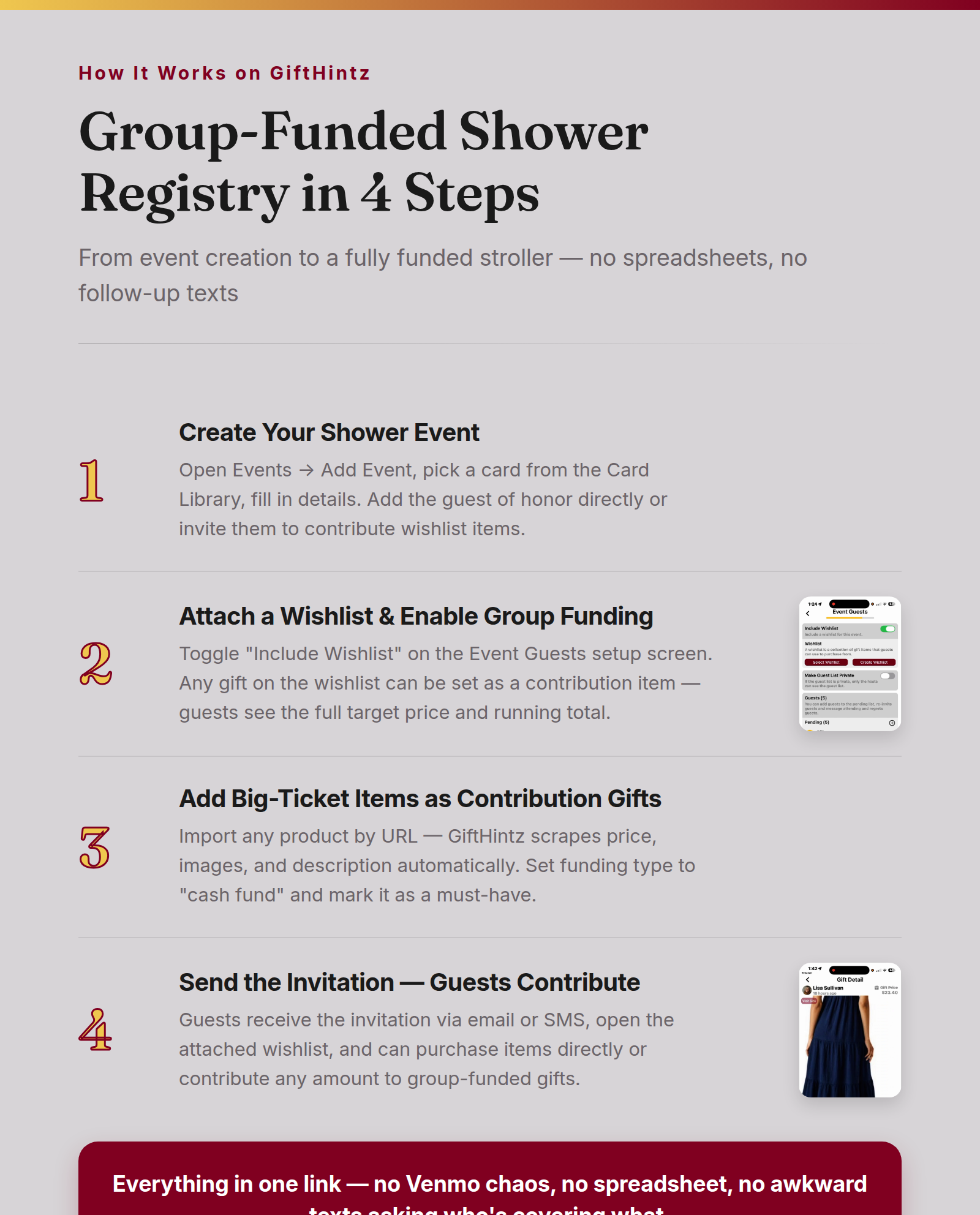
Setting up a group-funded shower registry on GiftHintz takes about ten minutes.
Create your shower event. Open the Events tab, tap Add Event, pick a card from the Card Library, and fill in the details. You can add the guest of honor directly — with a Surprise toggle if the shower is a secret — or invite them to contribute their own wishlist items so the registry reflects what they actually want.
Attach a wishlist and enable Group Funding. On the Event Guests setup screen, toggle “Include Wishlist” to attach a shared registry to the event. Any gift added to that wishlist can be set as a contribution item, which means guests see the full target price, a running contribution total, and a Contribute button for any amount they choose.
Add big-ticket items as contribution gifts. Import any product using its URL — GiftHintz scrapes the price, images, and description automatically from any retailer. Set the funding type to “cash fund” and mark it as a “must-have” so guests know it’s a priority rather than a nice-to-have.
Send the invitation. Guests receive the event invitation via email or SMS, open the attached wishlist, and can purchase smaller items directly, contribute toward group-funded items, or use a gift hint. Everything lives in one link — no Venmo coordination, no spreadsheet, no follow-up texts asking who’s covering what.
The reason fractional gift contributions work here is that the platform shows progress. Guests aren’t offering a fragment of something — they’re joining a group that’s showing up together. That reframe changes everything about how the ask lands.
“Listing Expensive Things” Isn’t the Problem
Here’s what nobody says at the registry appointment: putting a $900 stroller on your list isn’t presumptuous. What’s actually presumptuous is assuming guests would buy it solo, with no way to coordinate otherwise.
Group funding changes the framing. Instead of “this item costs $900,” your guests see “eight people are contributing to this — tap to add your amount.” The social proof carries the weight. The platform removes the coordinator tax. The host never sends a single awkward text.
For bridal and baby showers in 2026, the new etiquette is simply more honest than its predecessor: you need what you need, your guests want to show up for the moment, and both those things can happen without anyone feeling guilted, financially stretched, or left holding a fourth pack of burp cloths.
Set up your baby or bridal shower registry on GiftHintz, add essential big-ticket items with Group Funding enabled, and share your event invitation seamlessly — no spreadsheets, no follow-up texts, no group-chat chaos.