When someone you love hits a milestone — a retirement after 30 years, a 50th birthday, a college graduation — you want the gift to match the moment. But what keeps landing on the table? Another blender. Another gift card that expires in a drawer. Another appliance that requires four trips to the recycling center when they finally move.
Experience gifting is having its overdue moment. Concerts, cooking classes, weekend spa retreats, winery tours — the research backs up what most of us have quietly known for years: people remember what they did far longer than what they owned. A 2014 Cornell study by Thomas Gilovich confirmed that experiential purchases generate more lasting happiness than material ones. A decade later, that insight has moved from philosophy paper to mainstream gifting culture, with experience gifting growing as a category year over year as the data consistently confirms the intuition.
The problem has never been the instinct. It’s been the execution.
The Real Pain Point: Brilliant Idea, Logistical Nightmare
Consider the graduation dinner scenario. Twelve people want to chip in for a week at a mountain cabin. Someone floats the idea in a group chat. Forty-eight messages later, five people have Venmo’d the organizer $40 each, one has paid $20 “for now,” three haven’t responded, and the deadline to book has passed. The cabin costs $1,800.
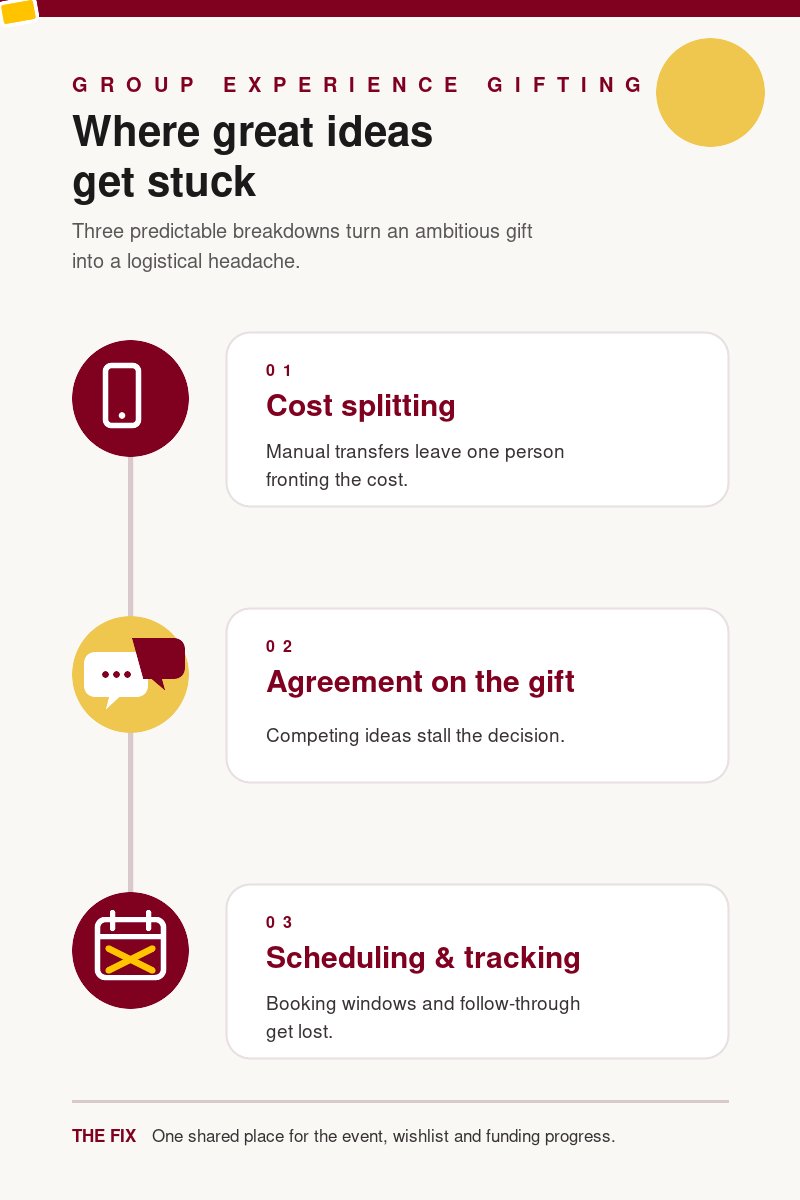
Group experience gifting breaks down in three predictable places:
Cost splitting. A weekend at a nice rental or a pair of front-row concert tickets is exactly the kind of gift that requires pooling — it’s too expensive for one person but well within reach for ten. When the coordination happens through text threads and manual bank transfers, someone always ends up fronting the cost and quietly resenting it.
Agreement on the gift. Material gifts carry a return option. Experiences carry a vision. If half the group wants “something outdoorsy” and the other half wants “something spa-like,” you need a structured way for the guest of honor to weigh in — or someone to curate an experience wishlist in advance.
Scheduling and tracking. Unlike physical gifts, experiences often need to be booked. That introduces lead time, availability windows, and follow-through — all of which can unravel without a central place to track status.
GiftHintz was built to solve exactly this. Not as a workaround, but as the infrastructure.
How GiftHintz Makes Experience Gifting Actually Work
The core loop is simple: create a milestone event, attach an experience-based wishlist, invite guests to contribute, and let the platform handle the coordination.
Here’s how it plays out in practice.
Step 1: Create your milestone event. Open GiftHintz and tap the Events tab. Start a new event — a retirement party, a graduation dinner, a milestone birthday gathering. Choose an invitation card from the library (there are templates for every occasion type), enter the details, and name your guest of honor. You can even enable the Surprise toggle if you want to keep the gift a secret until the event.
Step 2: Attach an experience wishlist. On the Event Guests screen, toggle on “Include Wishlist.” A dedicated wishlist is now connected to your event — separate from the guest of honor’s general wishlist, purpose-built for this occasion. Add the experience gifts you have in mind: concert tickets, a cooking class, a weekend getaway, a private wine tour. Use GiftHintz’s URL import to pull product details directly from any site, including booking platforms and Airbnb links.
Step 3: Mark high-ticket items for Group Funding. When adding a contribution gift — something like a $600 spa weekend or a $900 pair of premium concert tickets — select the contribution funding type. Friends can now contribute whatever amount makes sense for them, and GiftHintz tracks progress toward the goal. No one has to front the full amount. No one gets left holding a half-funded booking.
Step 4: Invite guests and share the wishlist. Send invitations through the platform via email or SMS. Guests receive a beautifully formatted invitation with direct access to the event wishlist. They can browse the experience options, contribute to the group funded item, or claim a standalone gift — all without a single Venmo request or spreadsheet row.
Step 5: Track it without chasing anyone. Your event dashboard shows responses, contributions, and gift status in real time. When the group funding goal is reached, you have everything you need to book the experience.
Templates for Different Milestone Occasions
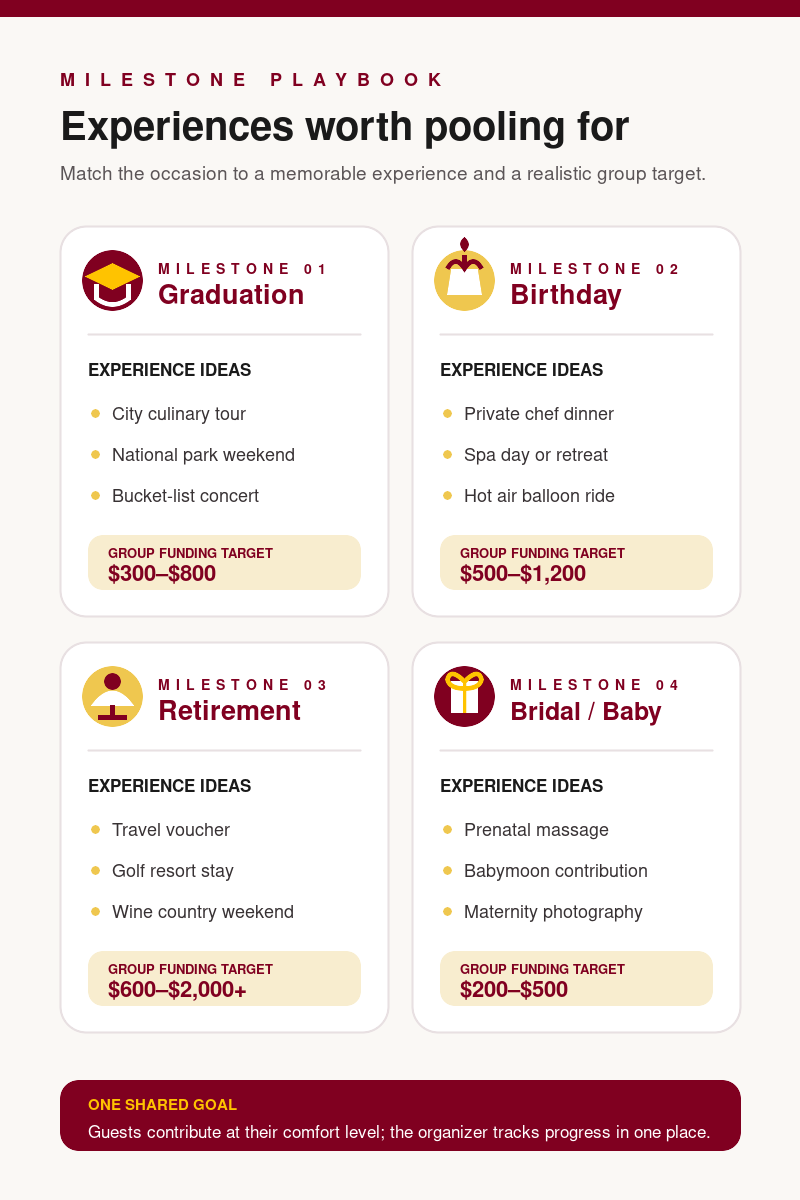
Different milestones call for different experience profiles. Here’s a starting set:
Graduation (college or advanced degree)
Experience ideas: city culinary tour, wine or cocktail class, weekend at a national park, concert tickets for a bucket-list artist, photography session, or a travel credit toward a first post-grad trip.
Group funding target: $300–$800 depending on guest count.
Milestone Birthday (40, 50, 60)
Experience ideas: private chef dinner, spa day or retreat, whiskey/wine tasting, theater or opera tickets, golf lesson package, hot air balloon ride.
Group funding target: $500–$1,200.
Retirement
Experience ideas: a “bucket list” experience travel voucher, golf resort stay, cruise deposit, cooking class series, art or ceramics workshop, wine country weekend.
Group funding target: $600–$2,000+ (retirement gifts skew higher because people have real affection and longer relationships to honor).
Bridal or Baby Shower (experience tier)
Experience ideas: prenatal massage series, “babymoon” getaway contribution, postnatal recovery package, new-parent cooking class, maternity photography.
Group funding target: $200–$500.
Why This Works Better Than Traditional Group Gifting
The blender problem is partly a coordination failure and partly a failure of imagination. Most group gift systems optimize for what’s easiest to coordinate — Amazon cash funds, gift cards, items with free returns — not what the recipient actually wants to remember.
Experience gifts require more coordination, which is exactly why they keep getting abandoned in favor of safe, forgettable alternatives. GiftHintz removes that friction without removing the ambition. The guest of honor can signal what they actually want by building the experience wishlist themselves. Guests contribute at whatever level feels right. The organizer never has to play money collector.
That’s not a small fix. It’s the difference between giving someone a new KitchenAid and sending them to culinary school for a weekend.
Create Your First Milestone Event on GiftHintz
Create your first milestone event on GiftHintz, add an experience gift to the shared wishlist, and invite friends and family to contribute — turn a memorable moment into a shared experience.
The Venmo chase is over. The group chat spiral is over. Your people show up, contribute what they can, and the guest of honor gets something they’ll be telling stories about in ten years — not something they’ll be recycling in three months.