Anti-clutter gifts are having a moment — and it’s not a coincidence.
Across social media, a quiet rebellion is reshaping how people think about giving and receiving. The thread? Nobody wants more stuff. Decluttering channels are pulling millions of views. Return rates are at all-time highs. And the average American home now contains over 300,000 items, a number so staggering it’s become a meme in itself.
The result: a growing wave of givers who would rather spend $80 on something that gets completely used up than drop $80 on something that sits on a shelf collecting guilt.
Welcome to the anti-clutter gift economy.
Why the "Useful But Forgettable" Gift Became the Best Gift
The shift isn’t about cheap gifts. It’s about disposability by design.
A $90 bottle of aged whiskey. A premium espresso subscription. A spa day. A set of artisan candles that actually smell like something worth burning. These are not throwaway presents — they’re intentional choices to give something that disappears beautifully, leaving only the memory of the experience and none of the clutter.
The consumer psychology driving this is straightforward: people are exhausted by return culture. The average American makes over 2 billion returns a year. Returning a gift feels awkward and wasteful. So does the gift-giver’s sheepish follow-up text: "Did you end up using it?"
Consumable gifts short-circuit that entire loop. No returns. No re-gifting guilt. No passive-aggressive question three months later.
But there’s a second force at work here too — the heirloom counter-trend.
The Two-Pole Anti-Clutter Strategy: Consumables + Heirlooms
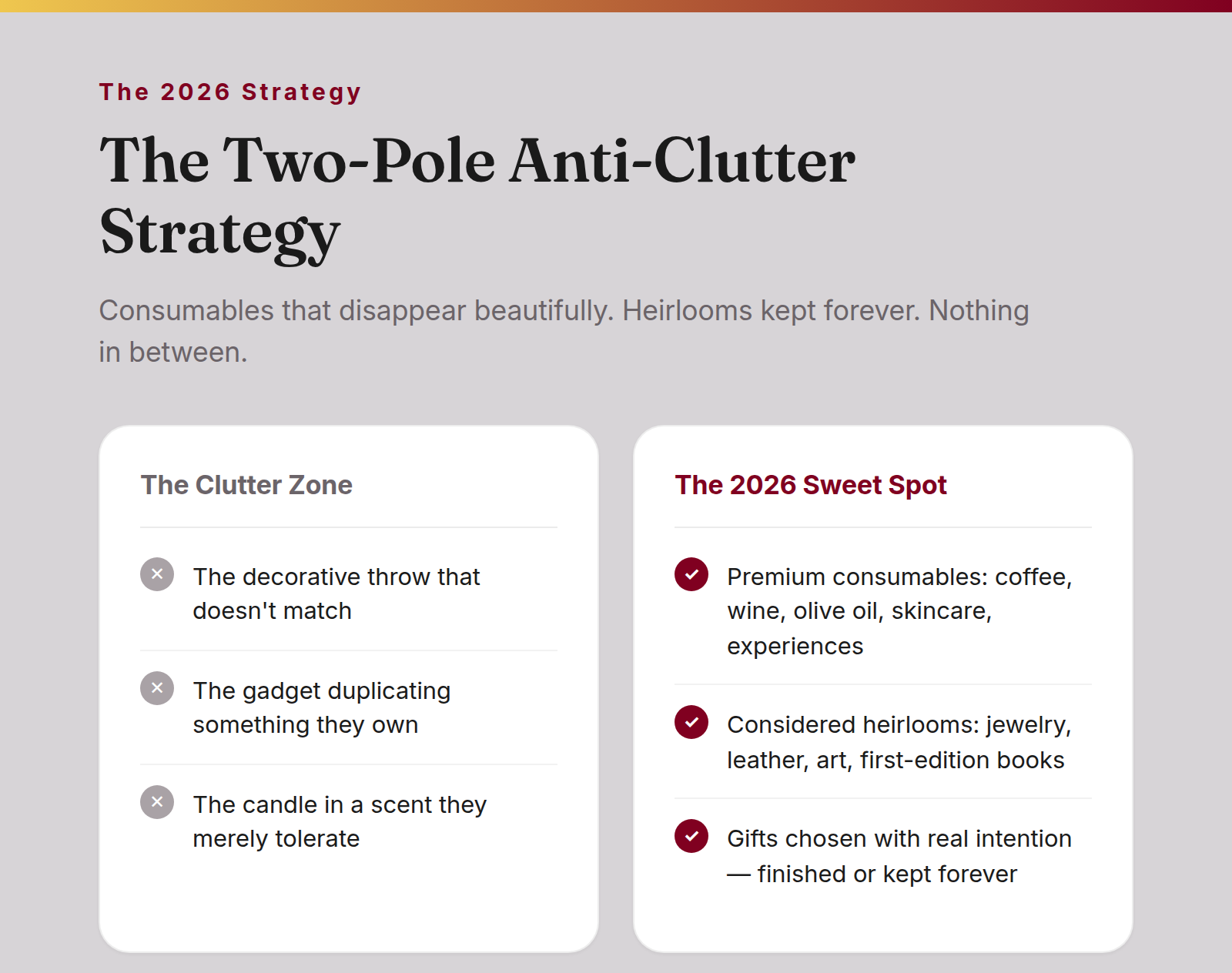
Here’s what’s interesting: the "anti-clutter" movement isn’t purely about things that disappear. It actually has two poles:
Pole 1 — Premium Consumables: Things that get used up. Coffee, wine, olive oil, perfume, experiences, skincare. They add value while they last, then exit without ceremony.
Pole 2 — Considered Heirlooms: Things that will be kept forever. Not clutter because they’re genuinely meaningful — a piece of jewelry made from the recipient’s birthstone, a handcrafted leather bag, a first-edition book of their favorite novel. These survive the "does this spark joy?" test because they were chosen with real intention.
The middle — the space between consumable and heirloom — is where most gift-giving goes wrong. The decorative throw that doesn’t match the apartment. The gadget that duplicates something already owned. The scented candle in a scent the recipient tolerates but doesn’t love.
Givers in 2026 are getting surgical about avoiding that middle.
The Coordination Problem Nobody Solved (Until Now)
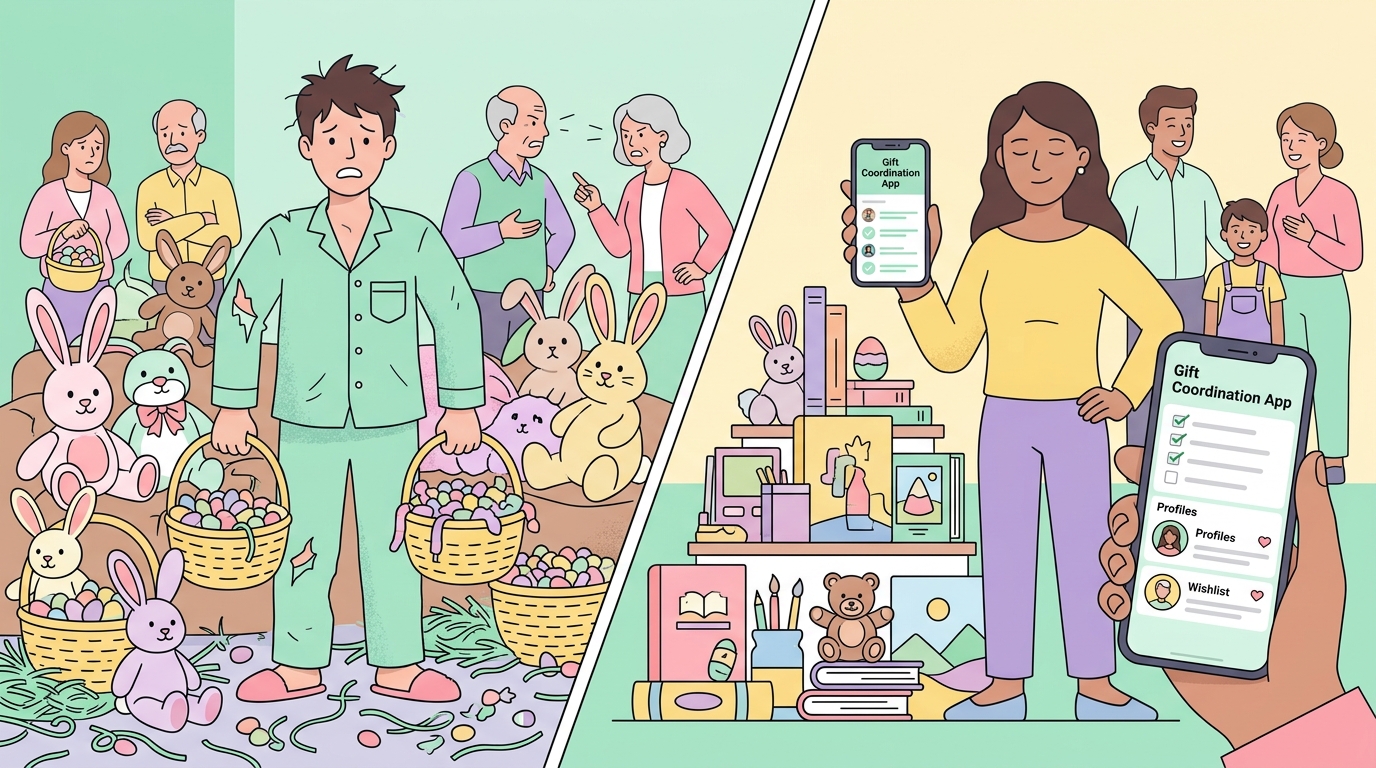
Here’s where it breaks down: even givers with the best intentions are flying blind.
You know your friend is into skincare. But is she currently drowning in serums, or has she been waiting for an excuse to try that $95 vitamin C treatment? You know your dad drinks whiskey. But is he a smoky Scotch guy or does he prefer bourbon?
The information gap between giver intent and receiver desire is where most "good ideas" go wrong.
The traditional fix — asking outright — works only sometimes. People downplay their wants. They say "oh, anything is fine." They recommend a $20 gift when you were ready to spend $150.
GiftHintz solves this by giving receivers a way to communicate clearly, and givers a way to receive that signal without the awkwardness of a direct ask.
How This Works in GiftHintz
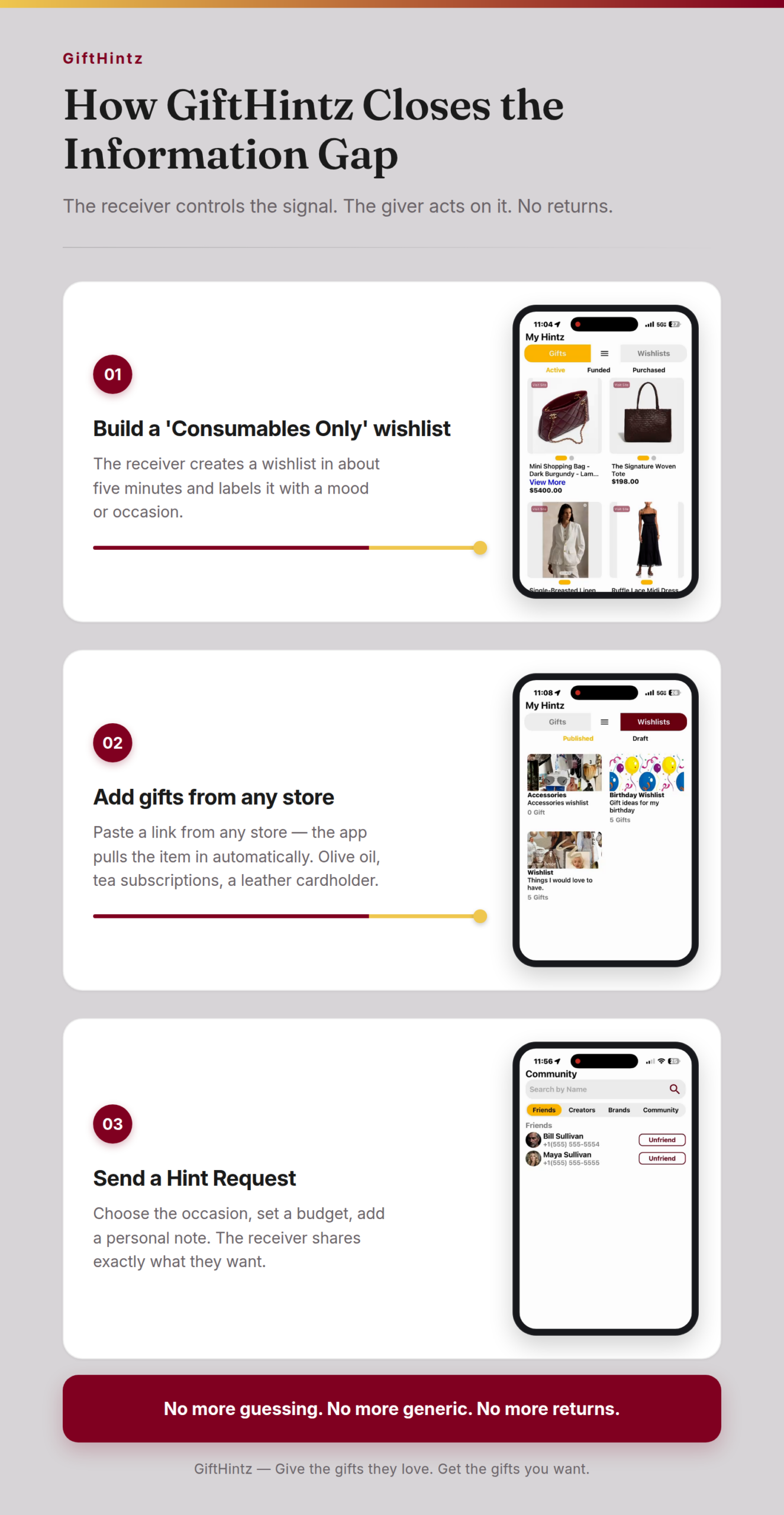
The flow is simple. The receiver builds a wishlist — takes about five minutes — and labels it with the mood or occasion. A "Consumables Only" wishlist. A "Things I’ll Actually Finish" collection. A "High-Ticket, Please Help" list for the one heirloom piece they’ve had bookmarked for six months.
They add gifts using GiftHintz’s URL import: paste a link from any store, and the app pulls the item in automatically. Olive oil from a small-batch Italian producer. A curated tea subscription. A leather cardholder from an independent maker. Everything lives in one place, organized by category or occasion.
When a giver wants to shop — for a birthday, a holiday, a random Tuesday when they feel like doing something nice — they send a Hint Request. Choose the occasion, set a budget, add a personal note. The receiver gets a structured prompt to share exactly what they want from their wishlist, and the giver gets to show up with a real gift.
No more guessing. No more generic. No more returns.
The receiver controls the signal. The giver acts on it. The result lands in the sweet spot every time.
What Smart Givers Are Saving Right Now
Not sure what falls in the "premium consumable" or "considered heirloom" category? Here’s where the trend is pointing:
Premium Consumables People Actually Love:
- Artisan olive oil or vinegar sets (under $60)
- High-end coffee subscriptions (12-month options available for $100–$180)
- Perfume or cologne samples/travel sets
- Natural skincare products they wouldn’t splurge on themselves
- Restaurant gift cards to places they’ve mentioned wanting to try
- Specialty spirits — single-origin mezcal, small-batch bourbon, natural wine
Considered Heirlooms That Don’t Become Clutter:
- Jewelry with personal significance (birthstone, initial, custom engraving)
- A leather wallet, bag, or belt that will last 10 years
- First-edition or signed copies of a book with meaning
- A piece of art — print or original — from an artist they’ve mentioned
- Quality cookware they’ve been putting off buying for themselves
The common thread: both categories require knowing the person. Which is exactly why the Hint Request flow changes everything.
Stop the Clutter. Give the Signal.
The gifting problem isn’t generosity. It’s information. Givers are willing to spend; they just don’t know where to land.
If you’re a receiver who’s tired of returns, politely smiling at things that don’t belong in your home, or watching your junk drawer fill up with well-meaning purchases — build a "Consumables Only" wishlist on GiftHintz. Add the premium skincare you’ve been eyeing, the subscription you want, the restaurant you keep mentioning. Send a Hint Request to your gift circle before your next birthday or occasion. Give them the signal.
And if you’re a giver — stop guessing. Ask for the hint. Your $80 will land exactly right instead of exactly wrong.
Build a ‘Consumables Only’ wishlist on GiftHintz for your next occasion and send a Hint Request — give your circle the signal to gift what you’ll actually use up.