Every gift list has one. The person who says "I don’t need anything" and means it. The one who bought themselves the thing you were going to get. The one whose taste is so specific that a gift card feels like a forfeit and a random pick feels like a gamble.
If you’re searching for hard-to-buy-for gift ideas at 11pm in November, this is your early warning system — and your solution.
The impossible giftee isn’t impossible. They’re just unsignaled. Here’s the playbook for ending the guessing game before December — without ruining a single surprise.
The Real Problem with Hard-to-Buy-for People
The "impossible giftee" label is code for a data problem. You don’t know what they want because nobody asked in the right way, at the right time, with enough specificity.
"I don’t need anything" is not a preference — it’s a deflection. It means: I have no idea what to tell you because nobody gave me a framework for thinking about it.
The fix isn’t a more creative search. It’s a better signal.
Step 1: Get the Signal by Mid-October
The single biggest mistake holiday givers make is waiting until November to start gathering intel. By then, the good stuff is backordered and your window for coordination has closed.
Target mid-October. (If you need the full case for starting early, our early holiday gift planning guide lays it out.) That gives you six to eight weeks to shortlist, coordinate, and buy before the holiday shipping crunch.
The most effective signal is a wishlist — not a vague verbal mention, but a structured, shareable list of actual products with real prices. When someone has curated their own wishlist on GiftHintz, adding items from any store via URL import, they’ve already done the taste-filtering for you — and if you want to understand why aesthetic fit matters so much right now, read about aesthetic-coded gifting in 2026. You’re not guessing; you’re executing.
If your impossible giftee doesn’t have a wishlist yet, the lightest ask is: "I want to get you something good this year — would you spend ten minutes making a list?" Frame it as a favor to you, not a task for them. Most people will.
Step 2: Send a Hint Request — Don’t Just Fish for Ideas
There’s a specific tool built for this exact moment: the Hint Request.
Here’s how it works: open your friend’s profile in GiftHintz, tap Request GiftHint, set the occasion (birthday, Christmas, anniversary), enter your budget range, and add a short personal note. Your friend receives the request and responds by sharing a curated slice of their wishlist — items that match your parameters, things they actually want.
The difference between a Hint Request and a vague group-chat message asking "what do you want?" is structure. You’ve told them the budget. You’ve named the occasion. You’ve given them a prompt. They’re not guessing what kind of answer you need — they can just point you at the right shelf.
The best note is specific: "I want to get you something you’ll actually use — not a gift card. Budget’s around $75. What’s on your list?" One sentence. No pressure. You’ll get a real answer.
The Etiquette of Asking Without Ruining the Surprise
Here’s what people worry about: won’t asking ruin the surprise?
Short answer: asking what someone wants is not the same as telling them what they’re getting.
You can ask for a list of twenty items and still choose one they’ve forgotten is on there. You can use a Hint Request to narrow from "infinite options" to "within their taste profile" and still create a genuine moment of delight on the day.
What ruins a gift isn’t knowing the category — it’s getting the wrong thing. A gift that lands is almost always one the receiver signaled in some way. The surprise lives in the how and when, not the what.
If you’re buying for someone who genuinely wants a surprise, you can still use their wishlist as a taste reference without buying directly from it. Use it to understand their aesthetic, their price range, their favorite brands — then find something adjacent they didn’t think to add. That’s actually a stronger gift than a straight wishlist pull.
How This Works in GiftHintz
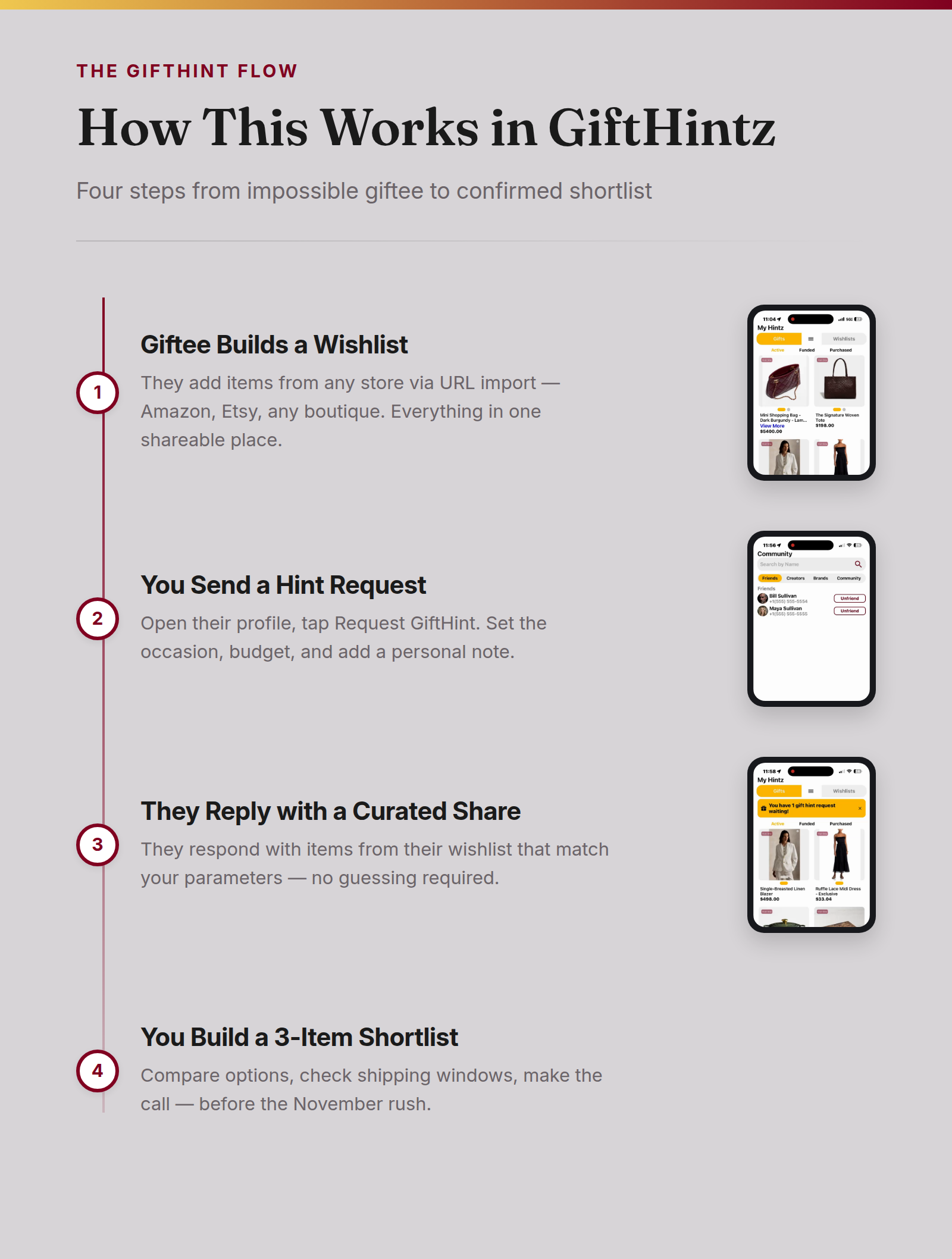
The flow is four steps:
- Your giftee builds a wishlist — they add items from any store using URL import. One link from Amazon, one from Etsy, one from a boutique they love. Everything in one place.
- You send a Hint Request — choose the occasion, set your budget, add a personal note.
- They respond with a curated share — items from their wishlist that fit what you asked for.
- You build a shortlist Collection — compare options, check shipping windows, make the call.
No group chat threads. No spreadsheet. No "oh, Sarah already got that." GiftHintz shows which wishlist items have already been claimed by other givers, so duplicate gifts become impossible — the same coordination logic that makes group gifting etiquette so much easier today.
Build Your Shortlist Before the Rush

Once you have signal, build a three-item shortlist Collection on GiftHintz. Not fifteen options — three. Import the URLs, compare prices and delivery dates, and make a decision before mid-November.
Three options forces a real choice. It ends the endless browse. And when a shipping delay or stock-out hits, you have an instant backup ready.
The impossible giftee becomes easy the moment you have three solid options that genuinely fit their taste. Signal first. Shortlist second. Buy third.
Stop Defaulting to the Gift Card
The gift card isn’t a gift — it’s a polite forfeit (the same trap that stings every Secret Santa exchange). It says: I couldn’t figure you out, so here’s money with extra steps.
The people on your list who seem impossible to buy for are impossible only because nobody has asked the right question in the right format. A shared wishlist and one Hint Request solve that in under ten minutes.
Create a GiftHintz wishlist for the hardest person on your list — or ask them to make one — and send one Hint Request to end the guessing game before December. The signal will arrive. The shortlist builds itself from there.