Somewhere in your extended family right now, three different people are planning to buy your child the same LEGO set.
Not because they lack imagination. Because nobody told them what was already covered, nobody wanted to ruin the surprise, and the group chat devolved into a read-receipt graveyard. PwC’s 2026 holiday spending data puts the average spend in households with children at $875 — roughly $200 more than households without kids. Every parent who has ever opened a kids holiday wishlist app and thought “this still doesn’t solve the actual problem” knows what that gap represents: duplicates, returns, and well-meaning relatives spending real money on gifts that miss.
A kids’ wishlist isn’t a simple registry. It’s a coordination surface for a dozen people with different budgets, different proximity to the child, and a shared obligation not to spoil anything. Getting it right requires a system — not a group chat.
The Duplicate Gift Spiral
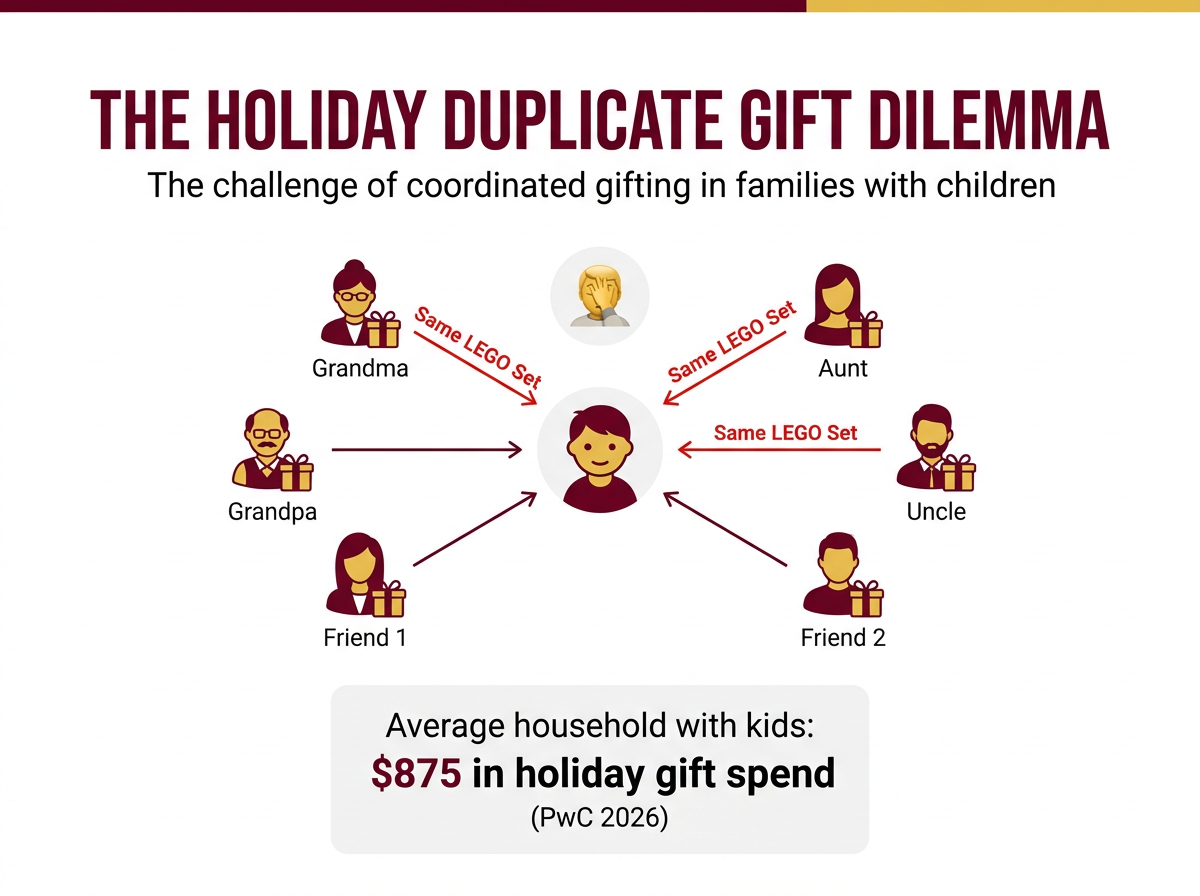
Every parent knows the scene: Christmas morning, three wrapped boxes, same toy inside. The kid is briefly confused. The givers are quietly embarrassed. Someone handles the returns in January.
The duplicate problem compounds in proportion to how many relatives are buying. A child with two sets of grandparents, two aunts, and three family friends has six independent buyers operating on zero shared information. Each one is solving the same puzzle alone: What does this kid actually want? What’s already been covered? What fits my budget?
Without a coordination layer, the answer to all three questions is a guess. The $875 average isn’t just spend — it’s the cost of six people each taking a shot in the dark and occasionally hitting the same target. If you’re already thinking about getting ahead of the holiday rush, building the wishlist now is the single highest-leverage move.
Why Kids’ Wishlists Are the Hardest Coordination Problem in Gifting
Adult wishlists are relatively straightforward. The recipient knows what they want, shares it, givers pick from the list. Done.
Kids’ wishlists have three complications that break this model.
The surprise constraint. Most families want the child to be genuinely surprised on the day. That means parents build the list, not the kid — or the kid contributes to it without seeing who’s buying what. The coordination has to happen invisibly.
The budget gap. Grandparents might be comfortable at $150. A college-age cousin is working with $25. The same wishlist has to serve both, which means it needs real price-range breadth — and ideally a way to pool contributions toward the one high-ticket item everyone knows the kid really wants.
The cross-retailer problem. The dream LEGO set is on Amazon. The personalized backpack is from Etsy. The art supply kit is from Michaels. No single retailer’s wishlist covers all three, so parents end up duct-taping lists across four platforms while relatives shop wherever feels easiest.
The Kids Holiday Wishlist App That Actually Coordinates
GiftHintz’s Universal Wishlist is built for exactly this scenario. From any retailer — Amazon, Etsy, Target, Michaels, a niche toy shop — parents paste a product URL and GiftHintz imports the price, images, and description automatically. One list, any store, every relative.
Here’s the setup: open GiftHintz, navigate to the Wishlists section, and create a new list for each child. Name it clearly — “Jake’s Holiday 2026” works; “Mia — Ages 7” works if you’re keeping multiple kids organized. Add a banner image to make it feel intentional (the app pulls from your photo roll so you can use a photo of the kid or a seasonal mood-board image). Then start adding gifts from any browser: paste the URL, choose a product image, assign it to the right wishlist, and move on. The whole setup takes under 10 minutes.
Once the list is built, it’s ready to share — but you control who sees it and what they can act on.
How This Works in GiftHintz
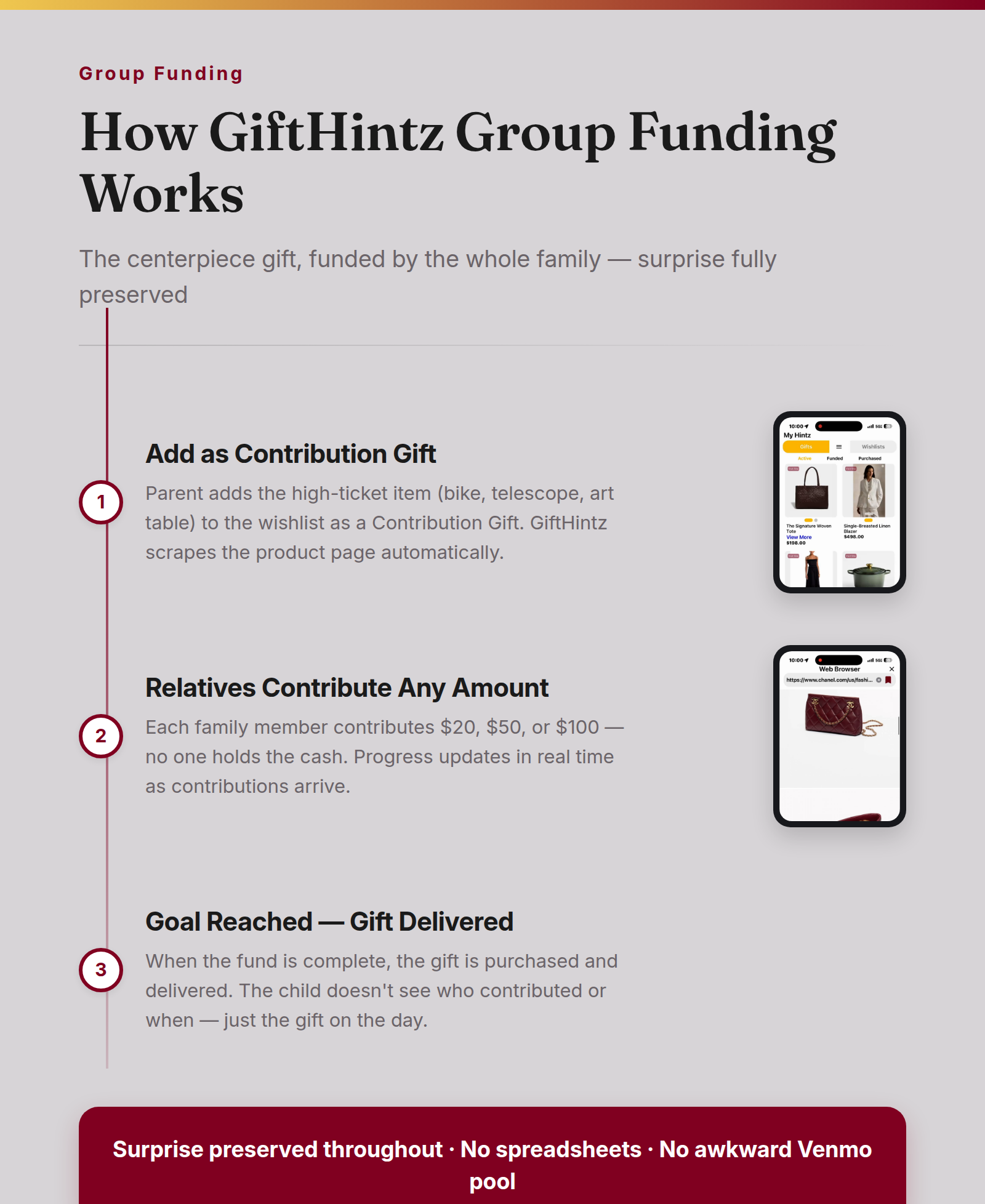
For a high-value gift — the gaming headset, the craft station, the bike nobody wants to buy alone — GiftHintz’s contribution mode makes pooling effortless. When adding the gift, select “Contribution” as the gift type. GiftHintz scrapes the product page automatically and flags the item as fund-eligible, so multiple relatives can contribute any amount toward it. The total tracks in real time; no one manages a spreadsheet or chases payments.
The child’s surprise is fully preserved throughout: they don’t see who contributed or when. They see the gift on the day.
Aligning Grandparents Without an Awkward Conversation
Hint Requests are how GiftHintz handles the budget-alignment problem without requiring anyone to have an uncomfortable money talk.
Once the wishlist is ready, the parent sends a Hint Request to each relative. Each request arrives as a direct, personal share — not a link blasted to a group. The parent can include a budget range (“Grandma, we’re thinking $50–$75”) and a short note. The relative opens the wishlist, sees items that fit, picks one, and it’s quietly marked as claimed so no one else buys the same thing.
The grandparent with a bigger budget sees the full list. The cousin with $25 sees what works in their range. Every item is something the child genuinely wants — not padding. And because each Hint Request is one-to-one, nobody’s budget is broadcast to the rest of the family.
For families coordinating across three or four households, this is the piece that usually falls apart in a group chat. Hint Requests make it structural instead of social — the system handles the disambiguation so the parent doesn’t have to. The same principle applies at larger milestone gatherings: see how modern group gifting etiquette has evolved to make these conversations easier.
Group Funding: One Big Gift, No One Left Holding the Cash
Some gifts are just too good to leave to chance. The bike. The telescope. The art table. These are the items parents circle in the wishlist and mentally earmark for “if someone wants to go in together.”
With GiftHintz’s Group Funding, the parent adds the high-ticket item as a contribution gift, and shares the wishlist link with the family circle. Relatives contribute any amount — $20, $50, $100 — and the progress updates as contributions arrive. When the goal is met, the gift is purchased and delivered. No one is awkwardly sitting on a Venmo pool, no one forgets to pay, and every contributor gets full credit for the present that makes the biggest impression. This same model works beautifully for adult milestones too — the approach behind micro-wedding group funding maps directly onto a child’s holiday centerpiece gift.
Build the Wishlist Before Anyone Asks
The coordination problem with kids’ holiday gifting isn’t that families don’t want to work together — it’s that the tools to do it haven’t existed. Group chats drift. Retailer wishlists lock you into one store. Spreadsheets require someone to appoint themselves warden.
Build each child’s wishlist on GiftHintz before the first “what does Jake want this year?” text arrives — which, based on PwC’s timing data, is coming before Halloween. Share it with the family circle via Hint Requests with suggested budget ranges. Enable Group Funding for the centerpiece gift. The $875 is going to be spent either way. The only question is whether it lands on three copies of the same thing or six gifts the kid actually wanted. Looking for gifts the whole family will appreciate? Explore thoughtful anti-clutter gift ideas that earn their place under the tree.
Build each child’s wishlist on GiftHintz and share it with the family circle — Hint Requests keep budgets aligned and Group Funding covers the one big gift.